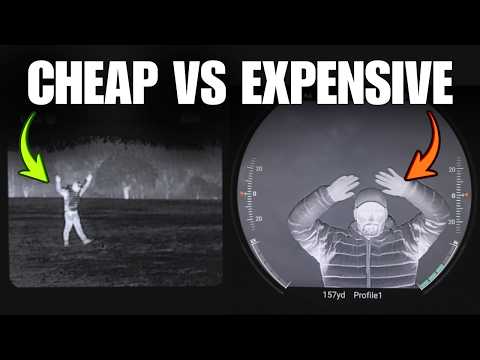
Shooting 1000yds With a Thermal

Published on July 17, 2025
Duration: 1:02

This video discusses the utility of laser rangefinding (LRF) features in thermal optics, particularly for night hunting scenarios like coyote hunts. The speaker highlights how LRF mitigates depth perception issues common in thermals at night, enabling accurate distance measurement. While the device claims a range of up to 1,000 yards, the speaker notes practical effectiveness for typical shots in the 200-400 yard range, suggesting extreme long-range use on coyotes at night is uncommon.

Quick Summary

Laser Rangefinding (LRF) is essential for thermal optics during night hunts, as it compensates for lost depth perception. The LRF emits a laser to accurately measure distances, proving highly effective for typical shots between 200-400 yards, though advertised ranges can extend to 1,000 yards.

Chapters

  1. 00:00Introduction to LRF Feature
  2. 00:05Importance of LRF for Night Hunting
  3. 00:16How LRF Works
  4. 00:30LRF Range Capabilities and Limitations
  5. 00:45Practical Application for Hunters

Frequently Asked Questions

Why is a laser rangefinder important for thermal optics during night hunting?

A laser rangefinder (LRF) is crucial for thermal optics during night hunting because it helps overcome the reduced depth perception inherent in thermal imaging at night. This allows hunters to accurately determine the distance to their target, which is vital for making ethical and effective shots.

What is the typical effective range of a laser rangefinder on a thermal optic for hunting?

While some thermal optics with LRF boast ranges up to 1,000 yards, practical effectiveness for typical hunting scenarios, such as coyote hunting at night, is often observed in the 200 to 400-yard range. Extreme long-range performance may vary and is less commonly utilized.

How does a laser rangefinder work with a thermal scope?

A laser rangefinder integrated into a thermal scope emits a laser beam towards the target. The time it takes for the laser to bounce off the target and return to the scope is measured, and this data is used to calculate and display the precise distance to the target on the scope's screen.

Related News

All News →

More Tactical & Gear Videos You Might Like

More from Elliott Delp

View all →