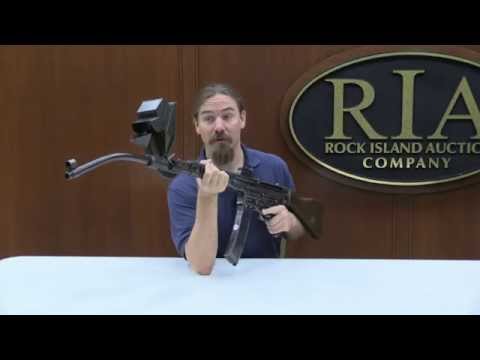
This gun shoots round corners: M3 Grease Gun 'Deflector' with firearms expert Jonathan Ferguson

Published on October 9, 2024
Duration: 22:59

This video details an experimental M3 Grease Gun 'Deflector' attachment, a curved barrel designed for armored vehicles to provide anti-personnel protection. Expert Jonathan Ferguson explains its function, design, and testing, noting its inability to shoot true 'around corners' but its effectiveness in close-range engagements. The attachment, a knockoff of the German 'Crumal', was tested by both US and British forces in the post-WWII era but never adopted.

Quick Summary

The M3 Grease Gun 'Deflector' was an experimental curved barrel attachment for armored vehicles, designed to provide anti-personnel protection. It fired .45 ACP rounds that deformed and tumbled, creating a wide dispersion pattern effective for close-range area denial from within tanks.

Chapters

  1. 00:03Introduction to the M3 Grease Gun Deflector
  2. 00:11Standard M3 Grease Gun Features
  3. 00:51What is the Deflector Attachment?
  4. 01:12Design of the Curved Barrel
  5. 02:12Unmodified Nature of the Attachment
  6. 03:00Infantry vs. Armored Vehicle Versions
  7. 03:54Purpose for Armored Fighting Vehicles
  8. 04:17Periscope Mount Adapter
  9. 05:15Attachment Mechanism and History
  10. 06:04The 'Infinity Site'
  11. 07:00Bracket and Lug Details
  12. 08:14Auxiliary Barrel Features
  13. 09:15Detaching the Deflector Unit
  14. 10:00Inside the Deflector Bore
  15. 11:08Barrel Nut Spring Failure
  16. 12:25Functionality and Traverse
  17. 13:30US Trials Summary (1951)
  18. 14:22Accuracy Assessments (Fixed vs. Free Gun)
  19. 15:25Shotgun Effect and Dispersion
  20. 16:02Bullet Deformation and Lethality
  21. 17:34Trial Conclusion and Recommendation
  22. 18:11Reasons for Non-Adoption
  23. 19:05Comparison to Modern Systems
  24. 21:19Crumal's Original Intent
  25. 21:31American Infantry Corner Engagement Ideas

Frequently Asked Questions

What was the purpose of the M3 Grease Gun 'Deflector' attachment?

The M3 Grease Gun 'Deflector' was an experimental curved barrel attachment designed for armored vehicles. Its primary purpose was to provide anti-personnel protection by allowing soldiers to fire from within a tank or armored vehicle, engaging threats at close range.

How did the M3 Grease Gun Deflector attachment work?

The attachment featured a significantly curved barrel that caused .45 ACP bullets to deform and tumble. This resulted in a wide dispersion pattern, creating a 'shotgun effect' effective for area denial and deterring close-range threats to armored vehicles.

Was the M3 Grease Gun Deflector designed to shoot around corners?

While the attachment allowed firing from a protected position and could direct fire around obstacles, it was not a true 'corner shot' system. Its design was primarily for anti-personnel defense from armored vehicles, not for precise engagement around sharp corners like modern systems.

What were the results of the US trials for the M3 Grease Gun Deflector?

Post-WWII US trials in 1951 found the deflector to be the most practical anti-personnel protection for tanks tested, with adequate accuracy and lethality out to 100 yards. Recommendations were made for its adoption, but it was ultimately not widely implemented.

More Tactical & Gear Videos You Might Like

More from Royal Armouries

View all →