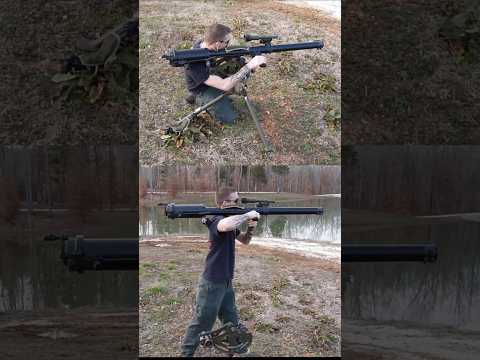
106mm M40 Recoilless Rifle

Published on November 30, 2023
Duration: 0:59

This guide details the firing procedure for the 106mm M40 Recoilless Rifle, emphasizing the use of the integrated .50 caliber spotting rifle for accurate target acquisition and range confirmation. Expert instruction covers loading, firing, and unloading, with critical safety considerations for backblast management.


Quick Summary

The 106mm M40 Recoilless Rifle firing procedure involves using an integrated .50 caliber T46E1 spotting rifle for accurate range confirmation before loading and firing the main 106mm round. Critical safety measures include ensuring the backblast area is clear and proper loading of the perforated ammunition casing.

Chapters

  1. 00:00Introduction and Setup
  2. 00:04Mechanical Adjustments
  3. 00:07Spotting Rifle Operation
  4. 00:13Loading the Main Gun
  5. 00:18Main Gun Discharge
  6. 00:35Unloading and Ejection

Frequently Asked Questions

How is the 106mm M40 Recoilless Rifle aimed and fired?

The M40 is aimed using traverse and elevation hand wheels. Range is confirmed with an integrated .50 caliber T46E1 spotting rifle before loading and firing the main 106mm round.

What is the purpose of the spotting rifle on the M40?

The .50 caliber T46E1 spotting rifle is used to precisely range targets. Firing it allows the operator to confirm the aim point and ensure accuracy before expending the more powerful 106mm main projectile.

What is unique about the 106mm M40 ammunition?

The 106mm rounds for the M40 feature a perforated shell casing. This design allows propellant gases to escape through the breech vents, counteracting the weapon's recoil.

What are the critical safety considerations for the M40 Recoilless Rifle?

The most critical safety concern is the massive backblast. The area must be completely clear of personnel and obstructions. Proper loading and breech closure are also vital.

More Training & Techniques Videos You Might Like

More from Forgotten Weapons

View all →