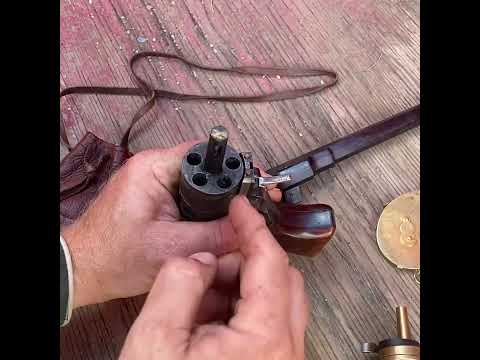
Civil War 1860 Colt - Loading Conicals

Published on July 6, 2023
Duration: 0:45

This guide details the historical process of loading a Civil War-era 1860 Colt Army revolver using conical projectiles. It emphasizes the use of 30 grains of 7ffg black powder and Johnston & Dow 210-217 grain conical bullets, demonstrating the proper seating technique with the integrated ramrod. The instruction comes from Karl Kasarda, highlighting historical accuracy in firearm operation.

Quick Summary

Loading a Civil War 1860 Colt Army revolver involves using 30 grains of 7ffg black powder and a 210-217 grain conical projectile from manufacturers like Johnston & Dow. The projectile's rebated rim aids in seating, and the integrated ramrod is used to firmly seat it into the cylinder for optimal performance.

Chapters

  1. 00:00Introduction to Loading
  2. 00:07Powder Charge
  3. 00:13Conical Projectiles
  4. 00:30Seating the Bullet

Frequently Asked Questions

How do you load a Civil War-era 1860 Colt Army revolver?

To load the 1860 Colt Army, first ensure it's unloaded. Then, pour 30 grains of 7ffg black powder into a chamber. Next, place a 210-217 grain conical projectile, like those from Johnston & Dow, onto the chamber opening and use the ramrod to firmly seat it.

What type of projectile is best for a Civil War 1860 Colt?

For historical accuracy and performance in a Civil War 1860 Colt Army revolver, conical projectiles weighing 210-217 grains, such as those made by Johnston & Dow, are recommended over round balls. They offer comparable ballistics to later cartridge conversions.

What is the correct powder charge for an 1860 Colt Army?

The historically accurate and recommended powder charge for the 1860 Colt Army revolver is 30 grains of 7ffg black powder. This charge provides appropriate power and performance for the period-accurate firearm.

What is a rebated rim on a bullet?

A rebated rim on a bullet, as seen on some Civil War-era projectiles for the 1860 Colt, is a design feature that helps the bullet seat more easily and securely into the cylinder chamber, ensuring a proper gas seal.

More Training & Techniques Videos You Might Like

More from InRangeTV

View all →