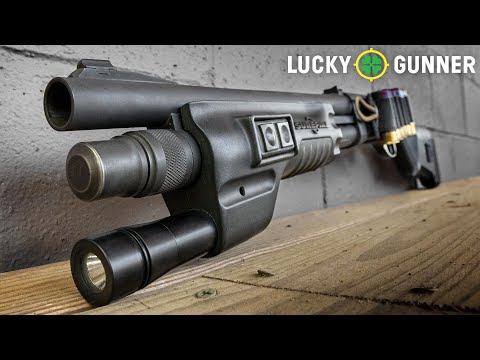
How Mossberg 500/590 Pump-Action Shotguns Work

Published on June 18, 2024
Duration: 2:51

This guide details the operational cycle of the Mossberg 500/590 pump-action shotgun, as explained with detailed 3D animations and precise nomenclature. It covers loading, feeding, chambering, locking, firing, extraction, and ejection, emphasizing the mechanical sequence for safe and effective operation. Instruction is provided with high authority, suitable for intermediate users.


Quick Summary

The Mossberg 500/590 pump-action shotgun operates through a manual cycle. Shells are loaded into the magazine tube, then fed into the chamber by the bolt. The action locks securely for firing. Pulling the trigger releases the hammer to strike the firing pin. Spent casings are extracted and ejected upon rearward cycling of the forearm.

Chapters

  1. 00:00Loading and Magazine Spring
  2. 00:19Feeding and Chambering
  3. 00:49Locking the Action
  4. 00:59Trigger and Firing Mechanism
  5. 01:30Extraction and Unlocking
  6. 01:41Ejection of Spent Casing
  7. 01:53Cocking and Resetting

Frequently Asked Questions

How does a Mossberg 500/590 shotgun load a shell?

Shells are manually loaded into the magazine tube. Cycling the forearm moves the bolt and elevator, which lifts a shell from the magazine and pushes it into the chamber.

What happens when the trigger is pulled on a Mossberg 500/590?

Pulling the trigger releases the sear, allowing the hammer to strike the firing pin. The firing pin then ignites the primer of the chambered shell, initiating the firing sequence.

How are spent casings removed from a Mossberg 500/590?

Rearward movement of the forearm unlocks the bolt. The extractor pulls the spent casing from the chamber, and as the bolt continues rearward, the casing strikes the ejector and is expelled through the ejection port.

What ensures the action is secure during firing on a Mossberg 500/590?

The bolt slide moves forward, camming the bolt lock upward into the barrel extension. This securely locks the action, containing the pressure generated during firing.

Related News

All News →

More Training & Techniques Videos You Might Like

More from MOSSBERG

View all →