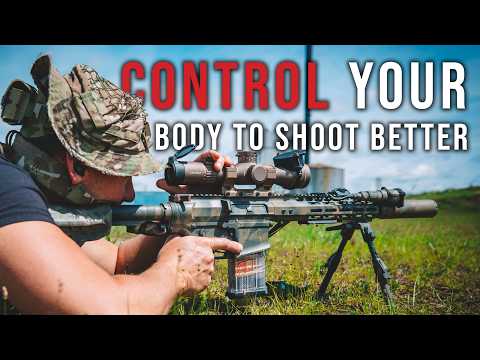
Long Range & Good Company

Published on December 19, 2025
Duration: 3:23

This video demonstrates critical communication and adjustment techniques for long-range shooting. It highlights the importance of clear spotter calls, precise target corrections (e.g., 'come up point one'), and confirming impacts to achieve accuracy. The session emphasizes iterative adjustments based on observed shot placement.


Quick Summary

Effective long-range shooting requires precise communication and iterative adjustments. Spotters provide impact calls, and shooters make corrections like 'come up point one' or 'left point three.' Verifying rifle levelness is also critical to eliminate cant as an accuracy variable.

Chapters

  1. 00:28Target Identification
  2. 00:40Initial Impact Call
  3. 00:56Correction: Low Left
  4. 01:26Adjustment: Come Up Point One
  5. 01:41Precise Aiming Adjustment
  6. 02:05Correction: Left Point Three
  7. 02:33Correction: Left Seven
  8. 02:40Correction: Come Down Three
  9. 02:57Check Levelness
  10. 03:10Correction: Left Point Six

Frequently Asked Questions

What are key communication elements for long-range shooting?

Effective long-range shooting relies on clear communication. Spotters provide impact calls like 'upper thoracic' or 'low left,' guiding the shooter. The shooter then makes precise adjustments, such as 'come up point one,' to refine their aim based on this feedback.

How are target corrections made in long-range shooting?

Target corrections are made iteratively. After an impact is called, the shooter adjusts their aim based on the deviation (e.g., 'left point three'). This process is repeated, making small, incremental changes until the desired accuracy is achieved.

Why is checking rifle levelness important for long-range accuracy?

Ensuring your rifle and optic are level is crucial for long-range accuracy. Cant (tilting the rifle) can significantly alter the point of impact, especially at extended distances. Checking for levelness, along with parallax, helps eliminate variables.

What does 'come up point one' mean in shooting?

'Come up point one' is a common spotter call instructing the shooter to adjust their aim upwards by a specific increment, often one-tenth of a mil (0.1 MRAD) or one minute of angle (1 MOA), depending on the system used.

More Training & Techniques Videos You Might Like

More from Milspec_Mojo

View all →