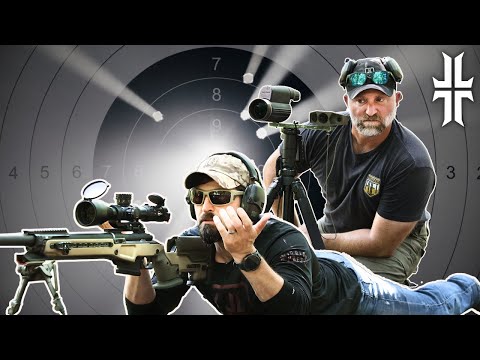
QUICK ZERO SA 5 METRO (DISCOVERYOPT LHD)

Published on July 17, 2024
Duration: 9:01

This video demonstrates a quick zeroing technique for rifle scopes, specifically the Discovery Opt LHD series, at close range (5-15 meters) before moving to longer distances. Instructor Harold Cabunoc highlights the importance of initial adjustments and the use of boresighting tools for efficiency. The scope's specifications, including its 4-16x magnification, front focal plane, and night vision capability, are also discussed.

Quick Summary

The Discovery Opt LHD rifle scope features 4-16x magnification and a front focal plane (FFP) design, making reticle subtensions consistent across all zoom levels. It is also HD night vision capable. For quick zeroing, start at 15 meters, make gross adjustments, and then fine-tune at 50 or 100 meters.

Chapters

  1. 00:00Introduction and Initial Setup
  2. 00:13Introducing the Discovery Opt LHD Scope
  3. 00:25Scope Specifications: 4-16x FFP, Night Vision Capable
  4. 00:39Zeroing the Scope: Daytime and Nighttime Plan
  5. 01:04Comparison to Previous Day/Night Scopes
  6. 01:21Scope Length and Mounting on M4
  7. 01:38Low Power View: Front Sight Post Visibility
  8. 01:56Elevation Adjustment: 1/4 MOA per Click
  9. 02:04Windage Adjustment and Parallax
  10. 02:13Testing with Night Vision
  11. 02:23Quick Zeroing Methods: Collimator vs. Boresight
  12. 02:48Field Expedient Boresighting Technique
  13. 02:55Initial Firing at 15 Meters
  14. 03:05First Shot Impact and Observation
  15. 03:22Aiming Point and Parallax Adjustment
  16. 03:46Observing Bullet Impact
  17. 04:05Initial Impact Analysis
  18. 04:09Second Shot and Paper Target
  19. 04:13Firing at 5 Meters
  20. 04:27First Adjustment: Heating Left
  21. 04:37Adjusting to the Right (Windage)
  22. 04:40Visualizing MOA Adjustments
  23. 05:03Calculating Adjustments for Distance
  24. 05:20Quick Mathematics by Ranger
  25. 05:32Small Adjustment Result
  26. 05:45Further Windage Adjustments
  27. 06:05Factory Zeroing Assessment
  28. 06:21Observing Scope Movement (Gumagapang)
  29. 06:38Windage Adjustments Continued
  30. 06:43Elevation Adjustment: Moving Up
  31. 07:00Expected Outcome of Elevation Adjustment
  32. 07:17Fine-Tuning Elevation
  33. 07:28Elevation Adjustments Continued
  34. 07:42Targeting the 'V' Ring
  35. 07:55Adjustments Still Needed
  36. 08:06Final Right Adjustment
  37. 08:11Aiming for the 'V' Ring
  38. 08:18Quick Zero Ranger Technique
  39. 08:35Final Adjustments and Impact
  40. 08:45Zero Achieved: Ready for 50 Meters
  41. 08:50Fastest Zeroing Technique Summary

Frequently Asked Questions

What are the key specifications of the Discovery Opt LHD rifle scope discussed in the video?

The Discovery Opt LHD rifle scope features 4-16x magnification, a front focal plane (FFP) design, and is described as HD night vision capable. Its turrets offer 1/4 MOA adjustments for both elevation and windage.

What is the recommended method for a quick scope zeroing according to the video?

The video suggests starting with a close-range zero at approximately 15 meters. After initial shots, make gross adjustments to the scope's windage and elevation turrets based on impact, then move to longer distances like 50 or 100 meters for fine-tuning.

How does the front focal plane (FFP) design benefit a rifle scope?

In a Front Focal Plane (FFP) scope, the reticle is positioned before the magnification lens. This means the reticle's subtensions (like MOA markings) remain proportional to the target size at any magnification setting, simplifying holdovers and range estimation.

What are the options for zeroing a scope if a collimator is not available?

If a collimator isn't available, the video suggests using a field expedient boresight. This involves visually aligning the scope's reticle with the rifle's iron sights or bore before live fire, or simply starting with live fire at a very close distance (e.g., 15 meters) for initial adjustments.

Related News

All News →

More Training & Techniques Videos You Might Like

More from Harold Cabunoc

View all →