

7.62x39mm: The Complete Guide
7.62x39mm sends a 123-grain bullet at 2,350 fps from a 16-inch AK barrel — heavy enough to tumble through tissue without fragmenting, cheap enough to have built the world's most popular rifle around it. Then Russia's ammo got banned and prices doubled overnight. Here's what the post-ban 7.62x39 market looks like in 2026.
The 7.62x39mm built the most produced firearm in human history — and then the country that made most of the ammo for it got sanctioned. That's the caliber's story in two sentences.
For decades, the AK-47's cartridge was the working person's rifle round: powerful enough to hunt deer, cheap enough to shoot all weekend, and so overbuilt for reliability that it earned a reputation for being indestructible. Then the 2021 Russian import ban rewrote the economics overnight. Everything you thought you knew about 7.62x39 pricing is obsolete.
The Quick Take
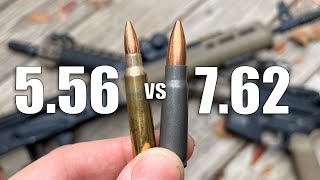
From a standard 16-inch AK barrel, a 123-grain Full Metal Jacket (FMJ) exits at 2,350 fps with 1,507 ft-lbs of energy — roughly 35% more muzzle energy than 5.56 NATO from the same barrel length. The round doesn't fragment like 5.56. It tumbles — yawing through tissue and creating a wound cavity from approximately 4 to 12 inches of penetration depth. Different mechanism, different terminal profile, different use case.
We analyzed ballistics testing, gel data, and platform reviews from Garand Thumb, Banana Ballistics, Brandon Herrera, Mrgunsngear, Tools&Targets, and more — cross-referenced with barrel-length velocity data from Rifleshooter.com and terminal performance testing from Brass Fetcher — to build the most complete 7.62x39 reference available.
7.62x39 is the intermediate rifle cartridge that trades precision for authority. It hits harder than 5.56 inside 200 yards, feeds reliably in the harshest conditions on earth, and powers a platform ecosystem — from Romanian WASRs to milled Arsenal AKs to the CMMG Mk47 in the AR world — that values function over finesse.
5.56 NATO vs 7.62x39: Unexpected Results
History & Development
On July 15, 1943, the Soviet Technical Council convened to solve a problem the Germans had already answered: infantry needed a cartridge between the full-power rifle round and the pistol cartridge. A committee led by N.M. Elizarov — with Boris Semin and others — theoretically considered 314 designs before constructing and testing eight physical models. The result, designated 57-N-231, was a 122-grain bullet in a heavily tapered case — the taper that would become the AK-47's signature curved magazine.
The design drew conceptual inspiration from the German 7.92x33mm Kurz but bore closer dimensional similarities to the GECO Vollmer M35 cartridge. The first variant had a 41mm case and a lead core. By 1947, the Ulyanovsk Machine Building Plant refined the design: a boat-tail was added for improved accuracy, the case was shortened to 38.7mm, and the core was switched to mild steel — a manufacturing decision that reused tooling from the 7.62x25mm Tokarev production lines.
Mikhail Kalashnikov designed the AK-47 around this cartridge shortly after World War II. The round's extreme case taper — unusual for a military cartridge — was specifically engineered for reliable feeding and extraction in adverse conditions. The cartridge was officially adopted for the SKS semi-automatic carbine in 1945, and the AK-47 followed in 1949. Together, they armed the Soviet military and every Cold War proxy conflict for the next four decades.
AK-47 vs AK-74: What's The Difference?
The American Market
Since roughly 1990, the 7.62x39mm has been a staple of the American civilian market. Cheap surplus SKS rifles and imported Romanian WASR-10s — combined with steel-cased Wolf and Tula ammunition at under $0.25 per round — created the "poor person's rifle" reputation. The caliber ranked among the most affordable centerfire rifle options in the country for decades.
That changed on August 20, 2021. Federal sanctions against Russia banned the importation of Russian ammunition — the dominant source of affordable 7.62x39. Prices doubled overnight. Brandon Herrera covered the immediate impact: steel-cased 7.62x39 went from budget ammunition to a scarce commodity in a single news cycle. The ban drove demand for 5.56-chambered AK platforms as a workaround and forced domestic manufacturers like Federal, Hornady, Winchester, and Advanced Armament Company (AAC) to expand production. Alternative sources from Serbia, Romania, and Poland have partially filled the gap — but the era of sub-$0.25 range ammo is over.
Ballistics Profile
The 7.62x39 is an intermediate cartridge that trades flat trajectory for raw energy delivery. From a 16-inch barrel, 123-grain FMJ produces 1,507 ft-lbs of muzzle energy — compared to 1,160 ft-lbs for 5.56 M193 from the same barrel length. The heavier bullet carries more momentum, which translates to better barrier penetration and more energy transfer at close range. The trade-off: a rainbow trajectory compared to 5.56, dropping significantly past 200 yards with a ballistic profile virtually identical to the .30-30 Winchester.
Caliber
7.62x39mm
7.62x39mm Soviet
Common Bullet Weights
122 / 123 / 154 gr
SAAMI Max Pressure
45,010 psi
CIP rated: 51,490 psi
Terminal Performance vs FBI Protocol
Penetration depth in ballistic gel. Green zone = FBI 12-18" standard.
Federal Hi-Shok SP 123gr
Brass Fetcher · 10% gel (FBI)
Hornady V-Max 123gr
Brass Fetcher · 10% gel (FBI)
Hornady SST 123gr
Mrgunsngear · 10% gel
Wolf 154gr SP
Brass Fetcher · 10% gel (FBI)
TulAmmo 122gr FMJ (baseline)
Mrgunsngear · 10% gel
Barrel Length vs Velocity
How barrel length affects muzzle velocity across common handgun sizes.
Barrel Length: Less Sensitive Than 5.56
One of the 7.62x39's genuine advantages is its barrel-length efficiency. The cartridge reaches approximately 90% of maximum velocity by the 12-inch mark — dropping from 2,421 fps at 20 inches to 2,250 fps at 12.5 inches, a loss of only 171 fps. Compare that to 5.56 NATO, which loses over 500 fps across the same range. The 7.62x39's lower operating pressure and faster powder burn mean it extracts most of its energy early.
For practical purposes:
| Barrel Length | Platform Example | Velocity | Energy | Notes |
|---|---|---|---|---|
| 7.5-inch | Draco pistol | 1,920 fps | 1,006 ft-lbs | Massive fireball, still viable |
| 10.5-inch | Zastava M92 / ZPAP92 | 2,125 fps | 1,233 ft-lbs | Popular pistol/Short-Barreled Rifle (SBR) length |
| 12.5-inch | CMMG Mk47 Dissent | 2,250 fps | 1,381 ft-lbs | Optimal for powder burn |
| 16-inch | Standard AK / PSA AK-103 | 2,350 fps | 1,507 ft-lbs | Civilian standard |
| 20-inch | SKS / RPK | 2,421 fps | 1,607 ft-lbs | Diminishing returns above 16-inch |
Garand Thumb identified the 12.5-inch barrel as optimal for the 7.62x39's powder burn characteristics when reviewing the CMMG Mk47 Dissent — the bufferless direct-impingement design with an AR-10 bolt ran 6,000 rounds including 1,500 suppressed at 2-3 Minute of Angle (MOA) with surplus ammunition.
Comparison to 5.56 NATO and .300 Blackout
The three intermediate rifle cartridges that share the AR-compatible ecosystem each have a distinct character:
| Metric | 7.62x39mm | 5.56 NATO | .300 Blackout |
|---|---|---|---|
| Velocity (16-inch barrel) | 2,350 fps | 3,081 fps | 2,215 fps |
| Muzzle energy | 1,507 ft-lbs | 1,160 ft-lbs | 1,340 ft-lbs |
| Terminal mechanism | Mass-dependent tumbling | Velocity-dependent fragmentation | Controlled expansion |
| Steel penetration (1/4-inch plate) | Passes through | Passes through | Fails |
| Ammo cost (range, 2026) | ~$0.45-0.55/round | ~$0.30-0.45/round | ~$0.65-1.00/round |
| AR-15 compatibility | Proprietary bolt + barrel + mags | Native | Barrel change only |
| Suppressed performance | Functional, limited ammo | Poor subsonic options | Optimized |
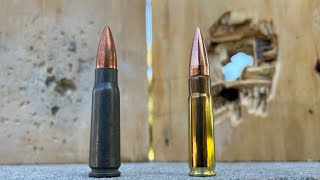
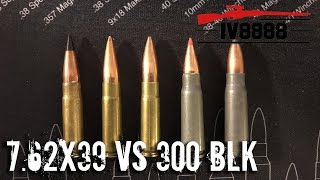
Banana Ballistics tested the steel penetration difference directly — 7.62x39 cleanly penetrated 1/4-inch mild steel plate while every .300 Blackout variant failed to punch through. Against soft barriers like lumber and sand, performance was roughly equal. The surprise result: 5.56 NATO outperformed 7.62x39 on 3/8-inch steel due to its higher velocity, creating a 0.340-inch crater versus 0.192 inches.
300 Blackout vs 7.62x39: SHOCKING Results On Steel
Terminal Performance
This is where the 7.62x39 tells a fundamentally different story than 5.56 — and where the distinction between FMJ and expanding ammunition becomes a matter of life safety.
The Tumbling Problem
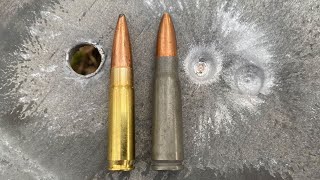
The M43-pattern 122-grain FMJ bullet does not fragment on impact. It tumbles — yawing through tissue and creating a significant wound cavity, but only after approximately 10 inches of initial penetration where the bullet tracks straight with minimal tissue disruption. Mrgunsngear demonstrated this clearly in ballistic gelatin — the TulAmmo 122-grain FMJ at 2,407 fps from a 16-inch Arsenal SLR-107R over-penetrated beyond 21 inches in every test, passing through two full 16-inch gel blocks.
The Yugoslavian M67 variant addressed this by removing the steel core and shifting the center of gravity rearward — forcing the bullet to destabilize 9 centimeters earlier. But both variants share the same fundamental limitation: FMJ 7.62x39 will likely exit a human torso before creating significant wound cavitation, posing serious over-penetration risk.
TulAmmo 7.62x39 FMJ Ballistic Gel Test
Expanding Ammunition Changes Everything
The gel test data paints a clear picture — expanding ammunition transforms the 7.62x39 from an over-penetration liability into a legitimate defensive and hunting round.
From Brass Fetcher's FBI-standard 10% ballistic gelatin testing:
| Load | Penetration | Expansion | FBI Window? | Assessment |
|---|---|---|---|---|
| Federal Hi-Shok SP 123gr | 14.0 inches | 0.63 inches | Yes | Best all-around — excellent expansion with solid penetration |
| Hornady V-Max 123gr | 12.3 inches | 0.61 inches | Barely | Explosive expansion, marginal depth |
| Wolf 154gr SP | 17.1 inches | 0.48 inches | Yes | Deep penetration, minimal expansion |
| TulAmmo 122gr FMJ (baseline) | 21+ inches | None | Over-penetrates | Dangerous for defensive use |
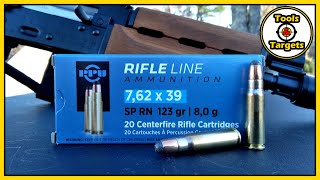
Tools&Targets ran the most comprehensive head-to-head test, naming PPU 123-grain Soft Point (SP) Round Nose the "best 7.62x39 round tested" — it delivered excellent expansion with over 120 grains of retained weight from both a 10-inch Zastava ZPAP92 and a 16-inch PSA GF3, outperforming all steel-cased soft points and hollow points.
The PERFECT 7.62x39 AMMO?
Garand Thumb's "M4 vs AK47: Which is deadlier?" test revealed the broader terminal comparison — the AK-47 with cheap FMJ was deadlier at close range than the M4 with standard ball ammunition, because the 7.62x39's mass transfers more immediate energy on impact. But with advanced ammunition like M855A1, the M4 pulled ahead due to consistent fragmentation. The implication for civilians: your ammo selection matters more than your caliber choice.
The Over-Penetration Reality
Standard M43 FMJ over-penetrates in every test. Every single one. If you are using a 7.62x39 rifle for home defense with military surplus FMJ, you are putting everyone behind your target at risk. Expanding ammunition — soft point or hollow point — is not optional. It's a safety requirement.
Recoil & Shootability
The 7.62x39 produces noticeably more felt recoil than 5.56 NATO — roughly 7-10 ft-lbs of free recoil energy from a standard AK versus 3.5-4.5 ft-lbs from an AR-15 in 5.56. Banana Ballistics demonstrated the side-by-side difference directly: the AK-47 produces visibly more muzzle movement and felt recoil than an AR-15 of similar weight.
That said, it's not punishing. The AK platform's heavy bolt carrier and long-stroke gas piston spread the recoil impulse across a longer time window than the AR's direct impingement system. It's a push, not a snap. New shooters can manage it — the rifle's weight (typically 7.5-8.5 pounds unloaded) absorbs much of the energy.
M4 vs AK47: Which is Deadlier?
The Muzzle Brake Factor
The AK-100 series slant brake and aftermarket compensators make a significant difference. Garand Thumb noted that the PSA AK-103's muzzle brake controls recoil effectively but generates substantial concussion for nearby shooters. If you're shooting at an indoor range, your neighbors will know about it.
Platform Weight Matters
- Full-size AK (7.5-8.5 lbs): Manageable recoil, easy follow-up shots
- AK pistol/SBR (5.5-6.5 lbs): Snappy with significant blast — muzzle brake or suppressor recommended
- AR-platform in 7.62x39 (6.5-7.5 lbs): Softer impulse from the AR buffer system, but heavier bolt carrier adds reciprocating mass
For comparison with other calibers: 7.62x39 recoils roughly 40% more than 5.56 NATO but significantly less than .308 Winchester. It generates comparable felt recoil to 10mm Auto in a handgun — which makes sense, since both cartridges were designed to deliver serious energy on target. If you can handle a 12-gauge shotgun, the AK feels tame.
Best Platforms
The 7.62x39 platform ecosystem is dominated by AK-pattern rifles, but bolt-action and AR-platform options have expanded significantly — especially as the AK import market shifts toward domestic and allied-nation production.
Hunting
Ruger American Ranch 7.62x39 — The go-to bolt-action option. Takes Mini-30 magazines, comes threaded, weighs under 6 pounds. TFB TV showed the Ruger American Ranch shooting 1 MOA groups with quality ammunition — accuracy that rivals rifles at three times the price. The rotary magazine and smooth bolt throw make it a genuine deer rifle for the 7.62x39 shooter. Guide coming soon.
Zastava ZPAP M70 — At 8.5 pounds with a chrome-lined Cold Hammer-Forged (CHF) barrel and bulged trunnion, the Serbian-made ZPAP is the AK hunting rifle by default. Heavy enough to tame recoil, accurate enough for whitetail inside 150 yards with soft-point ammunition. Guide coming soon.
CZ 527 Carbine — The miniature Mauser action in 7.62x39. Controlled-round feeding, set trigger, and genuine Mauser-quality fit and finish. It's been discontinued but remains highly sought on the secondary market. Guide coming soon.
Home Defense
PSA AK-103 — Garand Thumb ran 3,000 rounds with no issues through the PSA AK-103, including a mud submersion test — the FN Cold Hammer-Forged chrome-lined barrel, forged trunnion, and AK-100 series muzzle brake deliver reliability at the $899-1,000 price point. For home defense with expanding ammunition, it's the best value in the AK market. Guide coming soon.
CMMG Mk47 Dissent — If you want 7.62x39 in an AR-pattern rifle, this is the answer. Bufferless radial-delayed blowback, 12.5-inch barrel (optimal for the cartridge's powder burn), and an AR-10 bolt that eliminates the lug-cracking problem that plagued earlier 7.62x39 AR conversions. At $2,300, it's a premium option, but it ran 6,000 rounds — 1,500 suppressed — with high reliability. Guide coming soon.
Long Range / Precision
The honest answer: 7.62x39 is not a precision cartridge. Its rainbow trajectory — virtually identical to .30-30 Winchester — drops dramatically past 200 yards, and standard AK-pattern rifles produce 2-3.5 MOA groups with surplus ammunition. TFB TV's accuracy test showed the Saiga SGL-21 matching an AR-15 at 1.75 inches at 100 meters with Wolf steel-case — but that's the ceiling, not the floor.
For precision work past 200 yards, you need 5.56 NATO, .308 Winchester (guide coming soon), or 6.5 Creedmoor (guide coming soon).
Budget Builds (under $800)
WASR-10 — The Romanian import that introduced a generation to the AK platform. Century Arms-imported, Cugir-manufactured. Early examples had canted sights and magazine wobble — hickok45 covered both the Arsenal SGL-20 and WASR side by side, concluding the decision comes down to budget. Current production has improved significantly. Available under $800 when in stock. Guide coming soon.
PSA GF3 AK-47 — Palmetto State Armory's third-generation AK uses a forged bolt, carrier, and trunnion. It's the budget domestic option. Reliability has been solid in independent testing. Guide coming soon.
PSA AK-103: Affordable US-Made AK
General Purpose / Duty
Arsenal SAM7R — The milled-receiver Bulgarian AK. Machined from a solid steel billet rather than stamped sheet metal, the SAM7 is the AK equivalent of a custom 1911 — overbuilt, heavy (9.1 pounds), and smooth in operation. It's the prestige AK. Guide coming soon.
Zastava ZPAP M92 — The 10-inch barrel AK pistol that's become the default 7.62x39 SBR platform. Stamp it, brace it, or suppress it. At 2,125 fps from the short barrel, it's still delivering over 1,200 ft-lbs. Guide coming soon.
Ammo Selection
At approximately $0.45-0.55 per round for steel-cased FMJ as of March 2026, 7.62x39 has lost its historic cost advantage over 5.56 NATO — a complete reversal from the pre-ban era when it was the cheapest centerfire rifle cartridge to train with. Brass-cased hunting and defensive loads run $0.90-1.35 per round, comparable to .308 Winchester.
Hunting
PPU 123-grain SP Round Nose — The standout in every comparison test. Brass-cased, excellent expansion, over 120 grains of retained weight after gel impact. Tools&Targets rated it the best 7.62x39 round they've ever tested. Effective from both 10-inch and 16-inch barrels. Expect $0.90-1.10 per round as of March 2026.
Federal Power-Shok 123-grain SP — Domestic production with proven terminal performance. The bonded construction holds together for deeper penetration on medium game. Expect $1.00-1.15 per round as of March 2026.
Hornady BLACK SST 123-grain — The premium option with InterLock band for weight retention. Mrgunsngear's gel test showed the SST expanding to 0.54 inches and retaining 115 grains at 24-25 inches of penetration from a 20.3-inch SKS barrel — consistent across platforms but over-penetrating for home defense use. Best suited for deer at moderate ranges. Expect $1.10-1.35 per round as of March 2026.
Match / Precision
The honest recommendation: if precision is your priority, you're shooting the wrong caliber. That said, brass-cased Sellier & Bellot 123-grain FMJ and Lapua 123-grain FMJ produce the most consistent groups from bolt-action platforms like the Ruger American Ranch. For handloaders, Nosler produces 123-grain Ballistic Tip bullets and boxer-primed brass that will tighten groups beyond what factory ammunition delivers. Expect $0.90-1.20 per round for premium brass-cased match-grade as of March 2026.
Range & Training
Wolf / Tula 122-grain FMJ (remaining stock) — Steel-cased, berdan-primed, and the foundation of the AK training experience. Post-ban supply is finite — prices have stabilized around $0.45-0.55 per round as of March 2026. Be aware: bimetal jackets (steel core with copper jacket) are banned at many indoor ranges due to backstop damage and spark risk.
AAC Steel Case 123-grain FMJ — The domestic replacement for Russian imports. Non-corrosive steel-cased ammunition designed to fill the Wolf/Tula gap. Budget pricing.
Sellier & Bellot 123-grain FMJ — Brass-cased with boxer primers — reloadable, range-friendly, and more widely accepted at indoor facilities. The premium training option. Expect $0.55-0.75 per round as of March 2026.
Steel-Cased Ammo: The Myths
Military Arms Channel's "Truth About Wolf Ammo" debunked the most persistent misconceptions — modern Wolf and Tula ammunition uses polymer coating, not lacquer, and extraction failures are caused by rifle timing and over-gassing, not the ammunition itself. Carbon buildup — not lacquer residue — causes chamber sticking. Steel cases seal less effectively than brass, allowing more gas blowback into the action. Extractor wear from steel-case is "largely a myth" based on testing with thousands of rounds.
The legitimate concern: bimetal-jacketed bullets attract a magnet and are banned at many ranges. Check before you load up.
Subsonic
KLAYCO47 demonstrated suppressed subsonic 7.62x39 with a Dead Air Wolverine PBS-1 — sound reduction and recoil suppression were significant, with reliable cycling maintained during rapid fire. The catch: post-ban subsonic 7.62x39 ammunition availability is severely limited. If suppressed shooting is your primary use case, .300 Blackout (guide coming soon) was purpose-built for it and has a far deeper subsonic ammunition ecosystem.
Corrosive Surplus: A Warning
Older military surplus — particularly Chinese Type 56 and Soviet-era ammunition — uses corrosive primers that deposit potassium chloride salts in the barrel, gas system, and bolt face. These salts attract moisture and cause rust within hours in humid conditions. If you shoot corrosive surplus, flush the barrel and gas system with hot water or a dedicated corrosive-primer cleaning solution immediately after every range session. Standard bore solvent alone will not neutralize the salts.
Ammo prices fluctuate with supply and demand. Ranges above reflect pricing as of March 2026. Check AmmoSeek for current market prices.
Law & Compliance
The 7.62x39mm cartridge itself faces no caliber-specific bans. But the AK-47 platform — the most common rifle chambered in it — is banned by name in most assault weapon ban states. If you're buying a 7.62x39 rifle, your legal situation depends entirely on your state and whether your rifle has prohibited features.
Assault Weapon Restrictions
Seven states plus the District of Columbia maintain assault weapon bans that directly affect AK-pattern rifle ownership:
| State | Magazine Limit | Key Restriction |
|---|---|---|
| California | 10 rounds | AK banned by name; one-feature test; registration required for legacy |
| Connecticut | 10 rounds | AK banned by name; one-feature test; mandatory registration |
| Illinois | 10 rounds | AK banned by name under Protect Illinois Communities Act (PICA); endorsement affidavit required |
| Maryland | 10 rounds | AK banned by name; two-feature test |
| New Jersey | 10 rounds | AK banned by name; firearms purchaser identification required |
| New York | 10 rounds | One-feature test under SAFE Act; no pistol grips with detachable magazines |
| Washington | 10 rounds | AK banned by name; sale and manufacture prohibited; grandfathered possession legal |
California: Featureless AK Builds Are Harder Than AR
Unlike the AR-15, making an AK "featureless" in California is mechanically difficult. The pistol grip is integral to the AK design — it's part of the receiver, not an attachment. Fin grips and Kydex wraps exist but compromise ergonomics more severely than on an AR. Fixed-magazine solutions require field-stripping the receiver to reload. Standard 30-round AK magazines are prohibited — 10-round variants are available but rare. See California gun laws →
Illinois: PICA Grandfathering Deadline Passed
The Protect Illinois Communities Act banned the sale and manufacture of assault weapons including AK-pattern rifles. Existing owners were required to file an endorsement affidavit by January 1, 2024. If you missed the deadline, your rifle may be illegal to possess within the state. Note: Cook County has broader local ordinances that may cover additional semi-automatic firearms including the SKS. See Illinois gun laws →
New York: SAFE Act One-Feature Test
New York's SAFE Act defines an assault weapon as any semi-automatic rifle with a detachable magazine and one prohibited feature — pistol grip, telescoping stock, threaded barrel, flash suppressor, or bayonet lug. The AK-47 in standard configuration fails on at least three counts. Featureless configurations exist but are impractical for the AK platform. See New York gun laws →
The SKS Exception
The SKS in original configuration — with its fixed 10-round internal magazine, non-pistol-grip stock, and non-threaded barrel — is often treated differently under assault weapon bans. It lacks the detachable magazine and prohibited features that trigger the ban. However, aftermarket modifications (detachable magazine conversions, pistol grip stocks) can push an SKS into prohibited territory. Some local jurisdictions, including Cook County, Illinois, have broader bans covering more semi-automatic types. Check your local ordinances.
Federal Import Restrictions
Beyond state assault weapon bans, 7.62x39 buyers face two layers of federal import restrictions:
- Chinese military ammunition ban — Federal law classifies mild steel core rounds as armor-piercing, banning Chinese-manufactured M43 ammunition
- 2021 Russian import ban — Federal sanctions prohibit all Russian ammunition imports (Wolf, Tula, Barnaul brands), severely restricting the affordable ammunition supply
National Firearms Act (NFA)
Any 7.62x39 rifle with a barrel under 16 inches is a Short-Barreled Rifle (SBR) under the National Firearms Act (NFA) — requiring a $200 tax stamp and registration with the Bureau of Alcohol, Tobacco, Firearms and Explosives (ATF). The popular AK pistol workaround uses a stabilizing brace instead of a stock, though ATF rulemaking on braces has been subject to legal challenges.
Magazine and carry laws vary by state and change frequently. Before purchasing, confirm current regulations with a licensed dealer near you. Find your local FFL → — and tell them Cache sent you.
The Bottom Line
If you want an intermediate rifle cartridge that hits harder than 5.56 inside 200 yards, feeds through the most mechanically overbuilt rifle platform ever designed, and has enough energy to ethically take deer-sized game at moderate range — 7.62x39 is the round. The AK platform's reliability in adverse conditions is real, proven across 80 years and every climate on earth. The ballistics inside 200 yards are authoritative. The terminal performance with quality expanding ammunition meets every defensive and hunting standard.
But the economics have changed. The 7.62x39 that your father shot for pennies is gone. In 2026, 5.56 NATO is often cheaper to train with, fires from a more modular and more accurate platform, and has a dramatically deeper ecosystem of parts, optics, and accessories. If you're building your first rifle and don't have a specific reason to choose the AK platform, 5.56 NATO is the default answer — and it's the default for good reasons.
The people who should be buying 7.62x39 know who they are. You want an AK because you want an AK — because you value the platform's simplicity, its overbuilt reliability, its history. You're a hunter who already owns an AK and wants a soft-point that drops deer inside 150 yards. You're building a truck gun that needs to function after years of bouncing around a toolbox in the Arizona heat. For those use cases, nothing else feels right. Just buy the expanding ammo.
If you're considering a handgun instead, the caliber decision is entirely different — 9mm Luger dominates that conversation for the same reason 5.56 dominates rifles: it's accurate, affordable, and good enough.
Find a 7.62x39 dealer near you → | Check your state's laws → | Compare to 5.56 NATO → | Ask Cache about 7.62x39 →
Expert Video Library
Ballistics Tests & Chronograph
Gel Tests & Terminal Performance



Caliber Overview & History


Caliber Comparisons

Platform Reviews


Suppressed Shooting


Resources & Further Reading
Reference
- Wikipedia — 7.62x39mm — Cartridge history, military variants (M43, M67, 7N23), adoption timeline, and technical specifications.
- SAAMI Technical Information — Industry standards body for cartridge and chamber specifications.
Ballistics & Data
- ShootersCalculator.com — Ballistic Calculator — Free online trajectory calculator with wind drift and drop tables for 7.62x39 loads.
- AmmoSeek — 7.62x39 Price Tracker — Real-time price comparison across online retailers for all 7.62x39 ammunition.
Ammunition Manufacturers
- Federal Ammunition — Power-Shok 7.62x39 — Domestic production expanding to fill the import gap.
- Hornady — BLACK SST 7.62x39 — Premium hunting loads with InterLock technology.
- Sellier & Bellot — 7.62x39 Product Line — Brass-cased, boxer-primed imports from the Czech Republic.
Legal Resources
- Giffords Law Center — Assault Weapons State Laws — Searchable database of state-level assault weapon bans and feature restrictions.
- Handgunlaw.us — State Firearms Laws — State-by-state law summaries updated regularly.
Community & Forums
- AK Files Forum — The largest AK-specific community forum — build advice, import tracking, parts compatibility.
- Reddit r/ak47 — Active AK community with buyer's guides, ammo deals, and build documentation.
Sources & Research
Every claim in this article links back to the expert who made it. Go check our work.
Expert Videos
External Sources
Cross-referenced expert ballistics testing from Garand Thumb, Banana Ballistics, Brandon Herrera, Mrgunsngear, Tools&Targets, and Gun Dungeon across 24 independent videos — supplemented with barrel-length velocity data from Rifleshooter.com, terminal performance gel data from Brass Fetcher, and SAAMI specifications — to build the most complete 7.62x39mm caliber reference available.