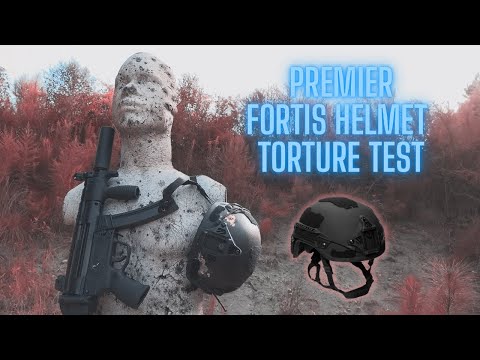
This video features Iraqveteran8888 conducting a comprehensive torture test of the Premier Body Armor Fortis Level 3A ballistic helmet. The helmet is subjected to various threats, including 9mm, .44 Magnum, 7.62x25mm AP, and 5.7x28mm rounds, to assess its ballistic performance and backface deformation. The review highlights the helmet's construction, adjustability, and comfort, concluding it exceeded expectations against multiple calibers.
This video details a comprehensive ballistic testing of the Premier Body Armor Fortis Level III+ GT plate, a NIJ RF2 rated armor designed as a lightweight alternative to Level IV plates. The testing involves multiple rifle caliber threats at close range (25 feet) and extended distances (100 yards), evaluating penetration and back face deformation. The plate demonstrates impressive performance against common threats like 5.56x45mm and 7.62x39mm, while also showing its limitations against higher-level threats at longer ranges as expected.
This video demonstrates the limitations of Level 3 body armor against specific ammunition types. While Level 3 plates successfully stopped .308 rounds, they were penetrated by M855 5.56 Green Tip ammunition. The presenter, identifying as a gun store employee rather than a professional tester, highlights that specialized plates like 'Special Threat' or 'Level 3 Plus' are necessary for protection against such rounds.
This video provides an expert-level test of a $30 Temu body armor panel, pushing it against various calibers from .22 LR to .500 S&W Magnum. The host, demonstrating high authority and expertise in firearms handling and armor assessment, meticulously documents the panel's performance, including significant deformation and structural compromise. While the armor stops many rounds, the instructor strongly advises against relying on it for life-saving applications due to questionable quality control and unknown manufacturing standards.
This video from Classic Firearms features a ballistic test of various body armor plates against common military calibers. Instructors Ka and Jason test Level III, Level IV, and Level IV+ GardDog ballistic plates against 7.62x39mm, 5.45x39mm (including steel core), 5.56x45mm (55gr, 62gr M855 green tip, 77gr OTM), and .308 Winchester rounds. They assess penetration and back face deformation, highlighting the capabilities and limitations of each armor level.
This video demonstrates the ballistic performance of Level 3A backpack armor against multiple handgun calibers. The armor successfully stopped rounds from 9mm, .40 S&W, 10mm, and .44 Magnum. The presenter highlights the importance of considering back face deformation, especially on edge impacts, and confirms the armor's effectiveness in stopping these threats.
This video tests the ballistic resistance of a DIY welding blanket armor against a .44 Magnum round. While a 9mm round was stopped with minimal back face deformation, the .44 Magnum presented a more significant challenge. The armor successfully stopped the .44 Magnum on a center mass shot, with a back face deformation of 39mm, which is within acceptable standards. However, an edge shot resulted in material blowout, indicating a potential vulnerability at the perimeter.
This YouTube Shorts video demonstrates the creation of DIY welder's blanket body armor using materials from a local hardware store. The description indicates a full video is available, which will detail the construction process and subsequent testing against NIJ Standards. The testing includes a ballistic clay box to assess both pass-throughs and back-face deformation. The video also promotes the creator's website for non-homemade armor solutions.
This expert-level analysis details a ballistic helmet's performance against various handgun calibers, culminating in a test with a .50 AE Desert Eagle. The Protection Group Denmark helmet, constructed from Aramid fibers, significantly outperformed a Chinese HDPE helmet, demonstrating minimal back face deformation even with powerful rounds. The instructor highlights the importance of helmet construction materials and their impact on survivability.
This video tests the ballistic resistance of Bullet Safe Level 4 body armor plates against various calibers, including handgun rounds, common rifle rounds, and extreme calibers like the 500 Nitro Express and 50 BMG. The instructor demonstrates the plates' effectiveness against rated threats and pushes their limits with unrated calibers, providing insights into penetration and back face deformation.
This video demonstrates a ballistic test comparing a WWII-era M1 Carbine firing .30 Carbine rounds against modern Battle Steel Level 3A+ body armor. The test, conducted by Civilian Tactical, effectively visualizes back face deformation on a particle board, showing the armor's ability to stop the projectile while containing fragments. The host, a firearms enthusiast, highlights the armor's performance in a controlled range environment.
This YouTube Shorts video from Predator Armor showcases their Non-Ballistic Trauma Pads. The description emphasizes their function in protecting against injuries caused by back face deformation by dissipating impact energy and reducing transmitted force. The pads are designed to be comfortable when worn with body armor, utilizing high-density, flexible materials to absorb impact and reduce blunt force trauma. A link to the full video and the product on their website is provided.
Gun Laws by State
Read firearms regulations for all 50 states + D.C.
Find Gun Dealers
Search licensed FFL dealers near you.