This video details the Lee Navy rifle, a limited production straight-pull rifle adopted by the US Navy. It highlights a critical design flaw where a gas vent channel could direct hot gas into the shooter's eye during case failures. A later modification involved adding a bolt shield, often riveted, to mitigate this issue, though these shields sometimes failed during service, notably during the Spanish-American War.
This guide details the process of installing and firing a .45 Colt conversion cylinder in a Remington Carbine, as demonstrated by Dustin on Guns of the West. It covers loading the cylinder, installing it into the carbine, and essential safety precautions for firing. The video also includes a velocity test comparing the carbine to a Colt Single Action Army, highlighting the ballistic advantages of the longer carbine barrel.
This guide details the manual loading, firing, and extraction process for the Snider-Enfield rifle, as demonstrated by Ian McCollum on Forgotten Weapons. It highlights the rifle's breech-loading mechanism and manual ejection, emphasizing the need for careful handling and a specific technique for spent casing removal. The information is presented with high authority and detailed mechanical knowledge.
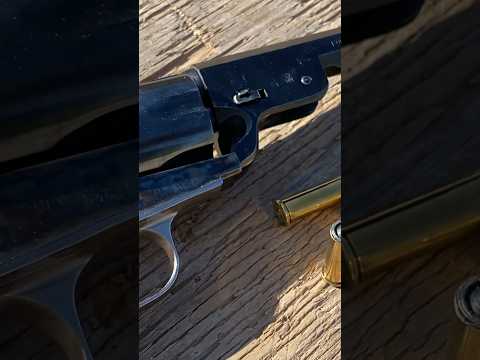
This video demonstrates an attempt at a historical trick shot: splitting a bullet on an axe head. The presenter uses a Colt 1860 Army cartridge conversion chambered for black powder cartridges. The challenge involves breaking balloons on either side of the axe head after the bullet impact. The attempt is made using both two-handed and one-handed shooting stances.
This guide details the process of converting a Remington New Model percussion revolver to fire cartridges, a common practice in the late 19th century. It covers the steps for removing the percussion cylinder and installing a conversion cylinder, as well as the procedure for reloading after firing. The video emphasizes that while these conversions were popular, they were often performed by gunsmiths rather than being a simple factory option until later.
This video showcases a .38 Special cartridge conversion single-action revolver, highlighting modifications made to improve its usability, such as an altered hammer spur and upgraded sights. The presenter emphasizes the enjoyment of shooting this firearm and the cost-effectiveness and ease of reloading .38 Special ammunition, noting the surprising quality of modern Italian imports.
This video provides an in-depth look at the Gallagher carbine, a Civil War-era breach-loading firearm. It details its design, operation, and historical context, highlighting its initial use of percussion caps and later conversion to metallic cartridges. The review notes its limitations, such as the lack of an extractor and a forearm, but acknowledges its place in Civil War firearm history.
This video provides an overview of various antique Colt firearms, presented by a firearms instructor who acknowledges his limited expertise in this specific area. He discusses models ranging from the Colt Paterson to later double-action and single-action models, highlighting key identifying features, historical context, and approximate market values. The presenter encourages viewer input to enhance collective knowledge about these historical firearms.
This video provides an expert-level deep dive into the Whitneyville Rolling Block Carbine, specifically the rare variant acquired by the Montreal Police. It details the carbine's unique Whitney-Laidley patent action, its historical procurement by the Montreal Police for riot control, and its distinctive markings. The presentation highlights the differences between Whitneyville and Remington Rolling Block designs and discusses the carbine's limited service life and current rarity as a collectible firearm.
This guide compares .38 Colt and .38 Special wadcutter ammunition, detailing their distinct bullet styles, weights, velocities, and propellant types. It highlights the interchangeability of .38 Special wadcutters with .38 Colt in firearms capable of handling smokeless powder, particularly relevant for 1851 Navy cartridge conversions. The information is presented with expert authority, focusing on technical specifications and compatibility considerations.
This guide details the process of converting a Colt 1851 Navy percussion revolver to a cartridge firearm using a Thuer conversion cylinder and ring. The conversion allows for the use of centerfire cartridges by replacing the percussion cylinder with a modified one and adding a conversion ring that incorporates a firing pin. The process involves removing the barrel and wedge, swapping cylinders, and reassembling the firearm, offering a reversible modification to modernize a classic black powder revolver.
This video details the unique operation and mechanics of a mid-19th century turret revolver, specifically a Heinrich Genhart design. It highlights the complex system involving a reciprocating barrel for gas sealing and an underhammer mechanism for ignition. The presentation emphasizes the intricate loading process for its custom cartridges and the reasons behind its limited production and eventual obsolescence.
Gun Laws by State
Read firearms regulations for all 50 states + D.C.
Find Gun Dealers
Search licensed FFL dealers near you.