This video provides an expert-level overview of the rare Latvian Charger-Loading Lee Enfield (CLLE) Cavalry Carbine, presented by Ian McCollum. It details the carbine's unique history, procurement by Latvia, technical specifications, and distinctive markings, including those from BSA and Tikkakoski. The presentation highlights the rifle's modifications and its service life, emphasizing its rarity today.
This guide provides a comprehensive overview of the Italian Carcano Moschetto 1891 carbine, covering both the Cavalry and Special Troops (TS) variants. It details unique features like the folding spike bayonet, cleaning rod storage, and sight adjustments. The information is presented with a focus on historical context and mechanical understanding, drawing from the expertise of C&Rsenal.
This video provides an expert-level overview of the 1873 Springfield Trapdoor Rifle in .45-70 Government, presented by firearms expert Hickok45. It covers the historical context of its development, technical specifications, the .45-70 cartridge, and a comparison between the rifle and carbine variants. The presentation highlights the rifle's historical significance and its place in firearms collecting, offering insights into its operation and performance with both modern and period-appropriate ammunition.
This video provides a historical and technical overview of the U.S. Model 1855 Pistol Carbine. It highlights its innovative Mayard tape primer system, its dual role as a pistol and carbine, and its ultimate shortcomings in military service due to issues with accuracy, handling, and competition from contemporary revolvers and rifles. The firearm's limited effectiveness during the Civil War is also discussed.
This video details the history and technical aspects of the Burnside Carbine, invented by Ambrose Burnside before the American Civil War. It highlights its innovative breach-loading mechanism and unique brass cartridge, comparing it to other Civil War firearms and noting its eventual obsolescence due to rapid technological advancements.
This video provides a detailed examination of the Argentine Mauser Model 1891 Carbine, highlighting its design differences from the long rifle, such as its shorter length, lighter weight, and specific features like the locking rear sight and magazine lock screw. It also touches upon its service history and variations, including Peruvian modifications and the use of Spitzer ammunition.
This review of the Swedish Mauser 1894/14 highlights its design for cavalry and specialty troops, weighing 7.5 pounds with a 44-inch overall length. The rifle uses a five-round stripper clip and the 6.5 Swede cartridge. Key features include a smooth bolt action, a comfortable turn-down bolt handle, a stiff safety, a long trigger take-up, and a protected Barleycorn front sight with a graduated ladder V-notch rear sight. A barrel extension was added to comply with U.S. import laws.
This video provides an in-depth look at the Green Carbine, an innovative breech-loading firearm developed by James Jarrell Green. Expert Jonathan Ferguson details its unique capping breech-loading mechanism, including the Maynard tape primer and a novel obturation system designed to prevent gas escape. The carbine's history, its limited adoption by British cavalry during the Crimean War due to cartridge issues, and its performance trials against other contemporary carbines are discussed. The presentation highlights the carbine's advanced features for its time, such as its effective rate of fire and accuracy.
This review covers the Finnish m/27rv Cavalry Carbine, a rare variant of the Mosin-Nagant. Produced by Tikkakoski between 1933-1934, it features a shortened barrel, a distinctive bent bolt handle influenced by the Kar98AZ, and a unique stock modification for bolt manipulation. The carbine saw service in the Winter and Continuation Wars, with most surviving examples exported to the US.
This guide details how to differentiate between the three main types of Chassepot-Gras cavalry carbines, focusing on receiver markings and production eras. It covers identification points for 'Manufacture Imperiale,' 'St. Etienne' script, and 'Manufacture d'Armes' markings, as well as conversion indicators and safety updates. The guide emphasizes visual inspection of historical firearm markings for accurate classification.
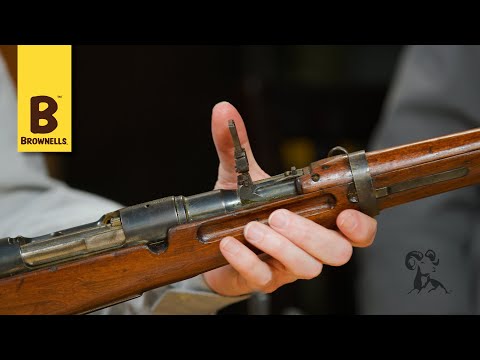
This "From the Vault" episode features Brownells Gun Techs Steve and Keith showcasing the Japanese Arisaka Type 38 Cavalry Carbine from World War II. They highlight its shorter and lighter design compared to infantry rifles, its original intended use for cavalry and rear-echelon troops, and its suitability as a potential "jungle carbine." The discussion delves into its chambering in 6.5x50mm Arisaka, its gentle recoil, and its straightforward action, which is similar to the Type 99. Specific features like the Mauser-style bolt, claw extractor, 5-round internal magazine, reinforcement tangs, side sling swivels, and barrel length are detailed. The episode also touches on the significance of the chrysanthemum stamp on the receiver and its impact on a rifle's value, emphasizing this particular carbine's excellent condition and historical significance.
This review of the Japanese Arisaka Type 44 Carbine, presented with high authority by Mae from C&Rsenal, details its design for cavalry use, featuring an integrated folding spike bayonet. The carbine shares the 6.5mm caliber and action with the Type 38 but is optimized for reduced belt clutter. Despite a sticky bolt on the tested example, the rifle demonstrates excellent gas mitigation and accuracy.
Gun Laws by State
Read firearms regulations for all 50 states + D.C.
Find Gun Dealers
Search licensed FFL dealers near you.