This video from Active Self Protection details a remarkable civilian self-defense incident where a 63-year-old woman successfully defended herself and others against an armed robber. The analysis, led by John Correia, highlights key principles of civilian defense, including recognizing threats, immediate action, the importance of 'Attitude,' and using improvised tools. The incident underscores the effectiveness of a proactive defensive mindset in critical situations.
This video analyzes the Supreme Court case Felix v. Barnes, which significantly impacts the 'moment of force' standard in legal proceedings. The ruling emphasizes the 'totality of circumstances' over a narrow focus on the immediate moment of threat, potentially broadening the scope of admissible evidence in both law enforcement and civilian self-defense cases. This shift could provide defendants with more robust legal defenses by allowing a fuller presentation of relevant events.
This video tests the '21-foot rule' in a civilian self-defense context using an airsoft gun and a simulated knife attack. The experiment suggests that 21 feet may not be sufficient distance to safely disarm an attacker, as the defender was 'killed' (shot with airsoft) but also 'stabbed' (simulated). The takeaway is that maintaining greater distance than 21 feet from a violent aggressor is advisable.
This video reviews the American Defense Solutions (ADS) "Got Your 6" Armor Panel, a NIJ Threat Level 3A rated personal armor shield designed for vehicle use. The presenter, nutnfancy, highlights its lightweight design, ease of deployment, and effectiveness against pistol calibers. While not rifle-rated, it offers significant protection for civilians and law enforcement in vehicle-based threats.
This guide, drawing from Civilian Tactical's expertise, outlines the discreet carry and rapid deployment of firearms using specialized gear like the Vertx Siege Pack 25L. It addresses the tactical considerations of carrying handguns versus rifles in civilian self-defense scenarios, emphasizing the importance of avoiding law enforcement misidentification. The content highlights the pros and cons of different firearm platforms and the necessity of quick access and stowage capabilities.
Hickok45, demonstrating high expertise, pragmatically assesses the relevance of revolvers in modern self-defense. He uses the 'Rule of Threes' to argue that for civilian encounters, a 5 or 6-shot revolver is statistically sufficient, comparing models like the S&W 65, S&W 642, and Kimber K6s against semi-automatics like the Glock 17. The video concludes that revolvers remain highly effective tools for the average citizen needing to 'get out of trouble'.
Former Marine Raider Cody Alford emphasizes adapting combat-tested self-defense principles to civilian life. He stresses the importance of continuous training, situational awareness, and overcoming complacency. Alford highlights how personal environments, like homesteading, necessitate adapting gear and mindset, particularly focusing on observation and communication skills over solely tactical engagement. He encourages individuals to overcome perceived high barriers to entry in self-defense training by focusing on fundamentals and making conscious decisions to improve preparedness.
Colion Noir, an experienced firearms commentator, critically analyzes statements made by Tim Walz regarding the AR-15 and military service. Noir emphasizes that the Second Amendment protects the right to bear arms, specifically mentioning the AR-15 as a civilian-owned firearm, not a 'weapon of war.' He argues against veterans using their service to justify infringements on constitutional rights, advocating for a defense of, rather than an attack on, the Second Amendment.
This YouTube video's title, "Explaining Why 9mm is the WORST Choice for Civilian Self-Defense!", directly challenges a common caliber choice and promises an explanation. While the description primarily focuses on promoting merchandise, backup channels, and viewer support, the core of the content is clearly a critical evaluation of 9mm ammunition for self-defense purposes. This suggests a comparative analysis or an in-depth discussion that aims to persuade viewers away from 9mm, likely advocating for alternative calibers or firearms.
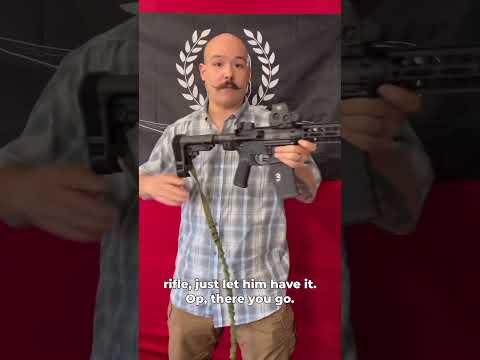
This guide outlines a controversial but potentially life-saving technique for civilian self-defense, as explained by Tom Holybee of Ashigaru Defense. The core principle is to avoid using a sling on a rifle, as it can be used by an assailant to control or disarm the owner. Instead, if a rifle is compromised in a struggle, the user should immediately relinquish it and transition to their sidearm to neutralize the threat. This approach prioritizes immediate threat neutralization over retaining a compromised long gun.
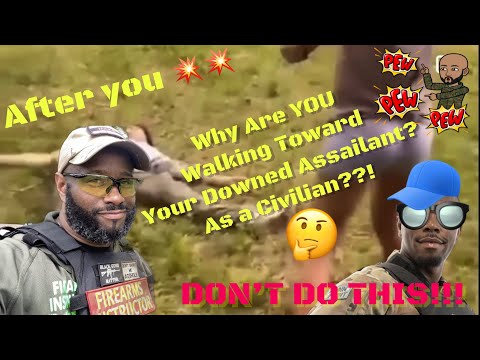
This video emphasizes critical post-engagement protocols for civilians. Instructor Mike stresses that a shot fired does not guarantee a hit, a hit does not mean the assailant is down, and down does not mean dead. Civilians are strongly advised against approaching a downed assailant, as this can create a new, immediate threat to their life.
This video, from Instructor Mike, strongly advises civilians against the law enforcement practice of 'following down' on a downed threat after a shooting. It emphasizes that civilians lack the legal obligation and face different risks compared to officers who must secure a scene for investigation and Fourth Amendment compliance. The core message is to disengage and exit the scene safely after neutralizing a threat, rather than approaching a potentially feigning assailant.
Gun Laws by State
Read firearms regulations for all 50 states + D.C.
Find Gun Dealers
Search licensed FFL dealers near you.