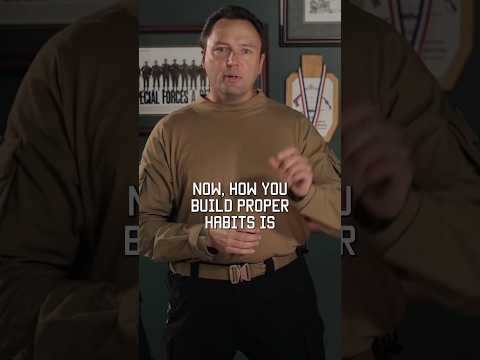
This video emphasizes the critical role of muscle memory in firearms proficiency, explaining how repetitive, perfect practice ingrains skills into the subconscious for faster, more efficient reactions in high-stress situations. It highlights the importance of dry-fire drills for consistent repetition and warns against developing bad habits due to the extensive effort required to correct them. Continuous practice is stressed to prevent skill degradation.
This video explains the flinch or anticipation response in shooting as a natural, protective reflex. It draws parallels to conditioned responses in animals, emphasizing that the explosion of a firearm is not a direct threat to the shooter's head, despite the instinctual reaction. Understanding this can help shooters avoid developing bad habits.
This video emphasizes the critical role of muscle memory in tactical performance. It explains that proper habits are built through perfect practice, leading to subconscious actions that are faster and more efficient than conscious responses, especially in high-stress combat situations. The core principle is that consistent, correct repetition is the only way to develop reliable subconscious performance.
This video, featuring Jason Pike, a Navy SEAL, focuses on the critical skill of trigger control in shooting. It highlights trigger control as the primary reason for missed shots and a challenging aspect for many shooters. The instructor explains and demonstrates the "Slack Out" trigger manipulation position, emphasizing its effectiveness. The video also touches upon the psychological elements of shooting, specifically "Conditioned Response" and "Synchronization," suggesting specialized training is needed to overcome them. The description promotes courses in California and Texas for in-depth training on these psychological factors.
This video from Jason Pike, associated with Navy SEAL training, focuses on a critical aspect of handgun marksmanship: trigger control. Pike emphasizes that improper trigger manipulation is the leading cause of missed shots and highlights the "Slack Out" position as the most effective technique. He acknowledges that psychological factors like Conditioned Response and Synchronization play a significant role and require specialized training to overcome. The video promotes further training courses offered in California and Texas for those seeking to delve deeper into these psychological elements of shooting. It also lists specific firearm accessories used, including a Trijicon RMR Type 2 optic, Streamlight TLR1 HL weapon light, Agency Arms trigger and mag bevel, Safariland holster, and High Speed Gear magazine pouches.
This video from Geauga Firearms Academy emphasizes the critical role of mechanics and repetition in developing fast and accurate shooting skills. Instructor Neil explains that proficiency is achieved when actions like drawing a firearm become a conditioned response, similar to instinctively catching an object. He stresses the importance of proper instruction to avoid 'training scars' and advocates for consistent practice to build muscle memory for drawing, presenting, and engaging targets effectively, noting that correct mechanics alone contribute significantly to accuracy.
Chris Sajnog, a retired Navy SEAL Chief and sniper instructor, presents a new framework for marksmanship training. He emphasizes mindset, planning, physics, focus, conditioned response, deliberate practice, and constant feedback as key to improving shooting skills, especially for civilians with limited training time and ammunition. The guide outlines a structured approach to practice, focusing on mental rebooting and breaking down complex skills into manageable parts.
You've reached the end! 7 videos loaded.
Gun Laws by State
Read firearms regulations for all 50 states + D.C.
Find Gun Dealers
Search licensed FFL dealers near you.