
Videos tagged with Gun University
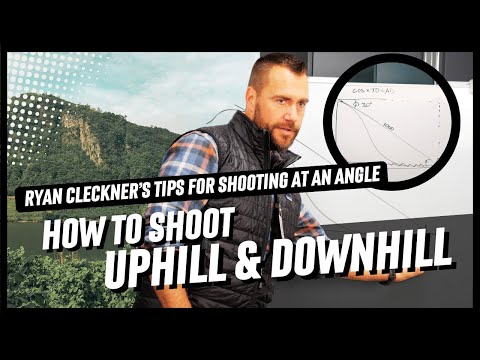
This guide details how to accurately shoot at uphill and downhill angles, a critical skill for long-range precision. Expert Ryan Cleckner, a former Special Operations sniper, explains the concept of Angle Distance versus True Distance and provides the trigonometric formula (Cosine(Angle) * True Distance = Angle Distance) for calculating necessary elevation adjustments. The guide emphasizes realistic angle estimation and the importance of using True Distance for windage calculations.

This video by Ryan Cleckner, a former special operations sniper, explains the difference between True MILs and NATO MILs and provides a simplified conversion method for shooters. Cleckner emphasizes using 3.5 as a practical 'fudge factor' for quick mental calculations between MOA and MILs in the field, making long-range shooting adjustments more accessible.

This video explains how to estimate target distance using a mil-based reticle in a rifle scope. It details the standard formula: Distance = (Target Size * Constant) / Measured Mils, and provides alternative constants for converting between inches, yards, centimeters, and meters. The instruction emphasizes the importance of knowing target size and accurate mil measurements for effective long-range shooting.

Ryan Cleckner, a former special operations sniper and author, demonstrates how to collect ballistic data (DOPE) for long-range shooting. He explains how to use milliradians (mils) to calculate elevation adjustments based on bullet drop, utilizing both ammunition box data and ballistic software like Kestrel. The process involves shooting at known distances, observing impacts, making adjustments in mils, and meticulously recording the data for future use with specific rifle and ammunition combinations.

This guide, presented by former Special Operations Sniper Ryan Cleckner, breaks down the practical application of Milliradians (MILs) in long-range shooting. It covers the fundamental definition of a MIL, how scope adjustments correlate to target impact, and the mathematical process for calculating necessary corrections. Cleckner also touches upon essential concepts like DOPE and the strategic advantage of a 100-meter zero, offering expert insights for intermediate to advanced shooters.

This guide details the critical steps for mounting a rifle scope, focusing on proper placement for shooter ergonomics and ensuring the scope is perfectly level. It emphasizes setting the scope for optimal eye relief by finding a comfortable shooting position and adjusting the scope's fore/aft position until a clear image is achieved without head strain. The process includes specific torque values for ring screws and the use of a leveling tool for accurate alignment, crucial for long-range accuracy.

This guide, presented by former Special Operations sniper Ryan Cleckner, details the essential components for mounting a rifle scope. It emphasizes selecting the correct scope base for your specific rifle and choosing the appropriate interface, like a Picatinny rail. The video also covers the importance of selecting scope rings or mounts that match the base interface, are the correct height to clear the rifle's barrel and bolt, and have the proper diameter for the scope body. Proper component selection is crucial for a stable and effective optic setup.

This video provides an expert-level comparison of First Focal Plane (FFP) and Second Focal Plane (SFP) rifle scopes, presented by Ryan Cleckner of Gun University. It details how reticle size changes with magnification in each type and offers practical advice for choosing between them based on shooting applications like hunting versus precision target shooting. The explanation highlights the advantages of FFP for accurate reticle measurements at all magnifications, while SFP offers cost benefits and better low-light visibility for hunting.

Ryan Cleckner, an expert from Gun University, emphasizes the critical but often overlooked importance of ocular focus for rifle scopes. Proper adjustment ensures the reticle is crystal clear, directly impacting shooting accuracy and comfort. This guide details a practical method for personalizing your scope's ocular focus, recommending it be checked before each range session for optimal performance.

Expert instruction from Ryan Cleckner of Gun University on optimizing scope magnification for improved accuracy. The video emphasizes that higher magnification is not always better, as it can magnify errors and target shake. Lowering magnification can stabilize the image, aid reticle focus, and is crucial for quick hunting shots.

This guide, based on instruction from Ryan Cleckner, details the critical process of parallax adjustment on rifle scopes. Proper adjustment ensures the reticle and target are on the same focal plane, preventing aiming errors caused by eye position shifts. It emphasizes using a 'head movement test' for precise calibration rather than relying solely on yardage markings. This technique is vital for accurate long-range shooting.
