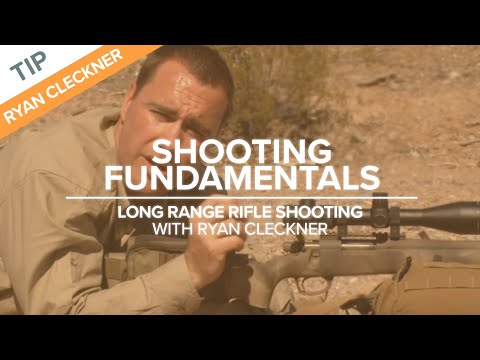
How to Shoot Uphill & Downhill | Ryan Cleckner’s Tips For Shooting at an Angle

This guide details how to accurately shoot at uphill and downhill angles, a critical skill for long-range precision. Expert Ryan Cleckner, a former Special Operations sniper, explains the concept of Angle Distance versus True Distance and provides the trigonometric formula (Cosine(Angle) * True Distance = Angle Distance) for calculating necessary elevation adjustments. The guide emphasizes realistic angle estimation and the importance of using True Distance for windage calculations.

Quick Summary

To shoot uphill or downhill accurately, adjust your aim lower than the true distance. Calculate the 'Angle Distance' using the formula: Cosine(Angle) * True Distance = Angle Distance. This accounts for gravity's effect on the horizontal plane. Always use True Distance for windage calculations.

Chapters

  1. 00:00Introduction to Angle Shooting
  2. 00:25The Golden Rule of Angle Shooting
  3. 01:28True Distance vs. Angle Distance
  4. 03:32Trigonometry and the Cosine Formula
  5. 05:33Estimating Angles in Nature
  6. 06:49Practical Calculation Examples
  7. 08:57Windage and Measurement Tools

Frequently Asked Questions

How do you adjust for shooting uphill or downhill?

When shooting uphill or downhill, the bullet impacts high. You must aim lower than the true distance suggests. Use the cosine of the angle multiplied by the true distance to find the correct 'Angle Distance' for elevation hold.

What is the difference between True Distance and Angle Distance?

True Distance is the direct line-of-sight range measured by a rangefinder. Angle Distance is the horizontal distance component, which is what gravity effectively acts upon. Angle Distance is calculated using the cosine of the shooting angle and the True Distance.

What formula is used for angle shooting calculations?

The formula for angle shooting is Cosine(Angle) * True Distance = Angle Distance. This calculates the effective horizontal range for ballistic drop adjustments. Remember to use True Distance for windage.

How steep are typical natural slopes for shooting?

Most natural slopes do not exceed 30 degrees due to the 'angle of repose.' Angles of 45 degrees are exceptionally steep and usually found on cliffs. Shooters often overestimate angles.

Related News

All News →

More Training & Techniques Videos You Might Like

More from NSSF—The Firearm Industry Trade Association

View all →