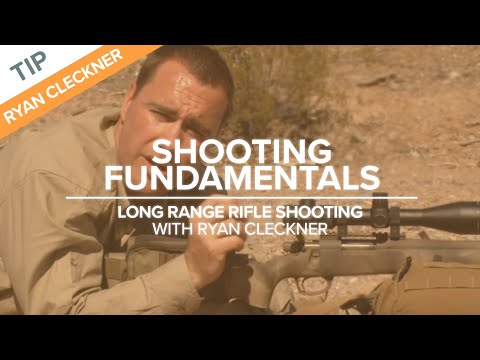
Understanding Minute of Angle (MOA) | Long-Range Rifle Shooting with Ryan Cleckner

This guide, presented by former sniper Ryan Cleckner, breaks down the critical concept of Minute of Angle (MOA) for long-range rifle shooting. It explains how MOA is an angular measurement that increases in linear value with distance, crucial for understanding bullet drop and making accurate scope adjustments. The instruction emphasizes calculating MOA at specific ranges and converting these to scope clicks for precise zeroing.

Quick Summary

Minute of Angle (MOA) is an angular measurement, 1/60th of a degree, crucial for long-range shooting. At 100 yards, 1 MOA equals approximately 1.047 inches, increasing linearly with distance. This concept allows shooters to precisely calculate and compensate for bullet drop and make accurate scope adjustments for zeroing.

Chapters

  1. 00:00Introduction to MOA
  2. 00:48Defining Minute of Angle
  3. 01:33Visualizing the Angle
  4. 02:23Calculating Adjustments
  5. 03:51Compensating for Bullet Drop
  6. 06:22Trajectory Examples
  7. 09:19Zeroing with MOA
  8. 11:18Scope Click Values

Frequently Asked Questions

What is Minute of Angle (MOA) in shooting?

Minute of Angle (MOA) is an angular measurement representing 1/60th of a degree. In practical terms for shooting, 1 MOA at 100 yards covers approximately 1.047 inches. This measurement's linear size increases with distance, which is crucial for long-range accuracy.

How does MOA help with bullet drop compensation?

MOA helps compensate for bullet drop by providing a standardized way to measure and adjust for the vertical deviation caused by gravity and velocity loss. By knowing the MOA value at your target distance, you can calculate the precise scope adjustments needed to counteract the bullet's trajectory arc.

What is the difference between MOA and inches at different distances?

MOA is an angular measurement, so its linear equivalent changes with distance. While 1 MOA is about 1 inch at 100 yards, it's about 2 inches at 200 yards, 3 inches at 300 yards, and so on. This is why understanding MOA is vital for accurate long-range shooting.

How do I convert MOA adjustments to scope clicks?

First, determine the required MOA adjustment based on your shot's deviation and target distance. Then, consult your scope's specifications for its click value (e.g., 1/4 MOA per click). Multiply the required MOA by the number of clicks per MOA to find the total clicks needed (e.g., 2 MOA up on a 1/4 MOA scope requires 8 clicks up).

More Training & Techniques Videos You Might Like

More from NSSF—The Firearm Industry Trade Association

View all →