
Videos tagged with Ryan Cleckner

This video from SHOT Show 2026 features Ryan Cleckner highlighting innovative products. He demonstrates the Caldwell Claycopter UFO Targets for aerial practice and showcases high-end precision rifles from Seekins Precision, noting their build quality and integrated suppressor systems. The segment also delves into Sonic Suppressors, specifically the Valor 9 and Skarv 22, discussing their modularity and noise reduction capabilities for various calibers.
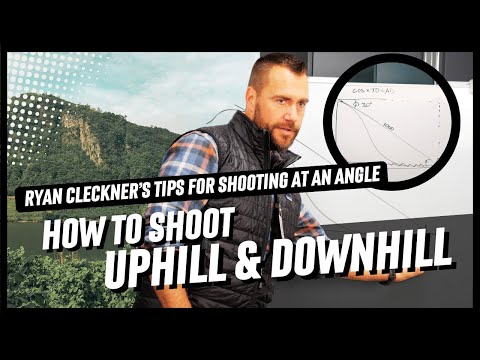
This guide details how to accurately shoot at uphill and downhill angles, a critical skill for long-range precision. Expert Ryan Cleckner, a former Special Operations sniper, explains the concept of Angle Distance versus True Distance and provides the trigonometric formula (Cosine(Angle) * True Distance = Angle Distance) for calculating necessary elevation adjustments. The guide emphasizes realistic angle estimation and the importance of using True Distance for windage calculations.

This video by Ryan Cleckner, a former special operations sniper, explains the difference between True MILs and NATO MILs and provides a simplified conversion method for shooters. Cleckner emphasizes using 3.5 as a practical 'fudge factor' for quick mental calculations between MOA and MILs in the field, making long-range shooting adjustments more accessible.

This video by Ryan Cleckner, a former Special Operations Sniper and author of the Long Range Shooting Handbook, explains the differences between Minutes of Angle (MOA) and Milliradians (MILs/MRAD) for long-range shooting. Cleckner emphasizes that neither system is inherently superior, but rather a matter of preference and communication. He advises choosing the system used by your shooting partners for clarity and suggests MILs for beginners due to its base-10 mathematical simplicity. The video also debunks common misconceptions about the precision of MOA vs. MIL adjustments.

This video explains how to estimate target distance using a mil-based reticle in a rifle scope. It details the standard formula: Distance = (Target Size * Constant) / Measured Mils, and provides alternative constants for converting between inches, yards, centimeters, and meters. The instruction emphasizes the importance of knowing target size and accurate mil measurements for effective long-range shooting.

Ryan Cleckner, a former special operations sniper and author, demonstrates how to collect ballistic data (DOPE) for long-range shooting. He explains how to use milliradians (mils) to calculate elevation adjustments based on bullet drop, utilizing both ammunition box data and ballistic software like Kestrel. The process involves shooting at known distances, observing impacts, making adjustments in mils, and meticulously recording the data for future use with specific rifle and ammunition combinations.

This guide, presented by former Special Operations Sniper Ryan Cleckner, breaks down the practical application of Milliradians (MILs) in long-range shooting. It covers the fundamental definition of a MIL, how scope adjustments correlate to target impact, and the mathematical process for calculating necessary corrections. Cleckner also touches upon essential concepts like DOPE and the strategic advantage of a 100-meter zero, offering expert insights for intermediate to advanced shooters.

This guide, presented by former Special Operations Sniper Ryan Cleckner, details how to gather Data on Previous Engagements (DOPE) in the field using Minutes of Angle (MOA). It covers using ammunition box data as a baseline, performing manual MOA calculations for specific distances and drops, comparing these with ballistic software, and refining adjustments through live fire. The importance of recording confirmed data for future use under similar conditions is heavily emphasized for mastering long-range accuracy.

This guide breaks down the concept of Minute of Angle (MOA) for long-range shooting, as explained by former special operations sniper Ryan Cleckner. It covers how MOA translates from an angular measurement to a linear distance at various ranges and provides practical methods for calculating and applying adjustments to hit targets accurately at extended distances. Understanding MOA is crucial for precision shooting.

Ryan Cleckner, known for rifle instruction, shares a key shotgun technique tip. He advises against aiming with sights and instead emphasizes a smooth body and eye movement to swing with the target. The core principle is to swing behind the bird, catch up to it, and pull the trigger as you pass, allowing the lead to naturally occur.

This video is the fourth part of a series focused on rifle scope mounting. Ryan Cleckner, a former Army Ranger sniper team leader and author, provides troubleshooting tips for common issues encountered during scope installation. The video also promotes helpful resources like Gun University's scope ring finder tool and Cleckner's "Long-Range Shooting Handbook."

This guide details the critical steps for mounting a rifle scope, focusing on proper placement for shooter ergonomics and ensuring the scope is perfectly level. It emphasizes setting the scope for optimal eye relief by finding a comfortable shooting position and adjusting the scope's fore/aft position until a clear image is achieved without head strain. The process includes specific torque values for ring screws and the use of a leveling tool for accurate alignment, crucial for long-range accuracy.