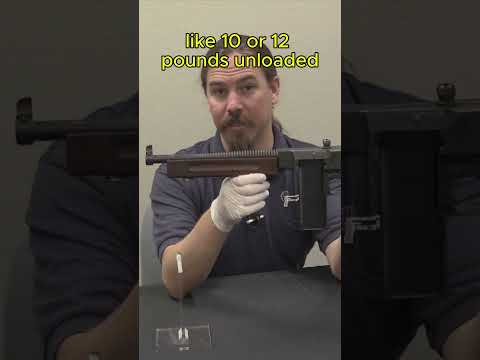
This video segment from "American Rifleman Television" explores the history of the Hi-Standard Model B pistol. Introduced in the early 1930s, it quickly became a popular rimfire handgun, rivaling the Colt Woodsman. The Model B is highlighted for its military service during World War II as a .22 caliber training pistol, allowing soldiers to practice marksmanship without expending valuable .45 ACP ammunition. The video details its simple blowback operation, 10-round magazine capacity, and distinctive grip design necessitated by the rimmed .22 Long Rifle cartridges. It mentions that 14,000 Model Bs were purchased by the Ordnance Department for training, playing a significant role in preparing soldiers for combat.
The Savage & North 'Figure 8' revolver, patented by Henry North, offered a unique mechanical design for its time. Its 'Figure 8' lever system allowed for rapid firing by cocking the hammer and rotating the cylinder simultaneously, a significant advantage over contemporary Colt revolvers. The design also featured an innovative sealed cylinder-barrel interface to reduce gas flash and was tested by the US military in 1856.
This documentary details the US Browning Model 1917 heavy machine gun's development and adoption for WWI. It highlights the US's initial lag in machine gun doctrine, the critical equipment shortages faced in 1917, and the rigorous trials that proved the 1917's superiority. Despite early production issues and criticism, the Browning 1917 became a reliable and effective weapon, serving through WWII.
This documentary details the US Browning 1917 heavy machine gun's development and adoption during WWI. It highlights John Browning's transition from gas to recoil operation, the 1917's superior performance in trials, and its efficient production by Colt, Remington, and Westinghouse. The video also covers the weapon's technical features, mechanical operation through animation, and its cost-effectiveness compared to competitors.
The Spencer 1871 Conversion transformed surplus Civil War carbines into infantry rifles using Springfield Armory's Model 1868 barrels. Key identifiers include the retained cavalry saddle ring and bar, two barrel bands, and the Stabler cut-off mechanism. These conversions, costing around $6.63 each, were intended for sale to France but were halted by President Grant, remaining in storage.
This video delves into the historical evolution of rifle stocks, specifically focusing on how the National Match competitions at Camp Perry significantly influenced firearm design during the interwar years. It highlights Springfield Armory's shift from production rifles to dedicated National Match variants with features like heavy barrels and pistol grip stocks. The discussion then extends to how these design changes, particularly the adoption of the pistol grip stock for improved accuracy and controllability, led to the development of the M1903A1. The video also touches upon the logistical challenge of leftover WWI stock blanks and the subsequent creation of the 'Scant' stock for the M1903A3 and M1903A4.
This review details the OSS Stinger, a disposable .22 Short pistol designed for covert WWII operations. It highlights three variants (T1, T1E1, T2) and explains the single-shot firing mechanism activated by a pocket clip. Early models suffered significant reliability issues, leading to redesigns like the T2 with a reinforced breech. Despite no documented operational use, these weapons are noted as dangerous due to their sensitive triggers.
This video delves into the historical purpose of the 1903 Springfield Air Service rifle, challenging previous assumptions. Expert analysis, drawing from new archival evidence, reveals its intended role as an emergency combat arm for pilots. The discussion highlights the preference for semi-automatic rifles like the Winchester 1907 for aerial combat and explains the Ordnance Department's decision to adopt the 1903 Springfield.
This review examines the White-Merrill Experimental Model 1911, a unique delayed blowback prototype that was never officially submitted for testing. Unlike the adopted Colt-Browning 1911, this design features a rotary hammer and a novel friction-based locking system. The pistol shares some aesthetic similarities with the earlier 1907 model but differs significantly in its internal mechanics and single-stack magazine configuration.
This review details the Winchester M2 prototype, a rifle that evolved from the G30M and was intended as a potential M1 Garand replacement. It incorporated elements like the Garand's rotating bolt and David Williams' short-stroke tappet gas system. Though refined, the M2's design was ultimately adapted into the M1 Carbine, with the M2 prototype itself being shelved.
This video is a book review of "Hatcher's Notebook," a seminal reference work on early 20th-century firearms development. The reviewer highlights Captain and Major General Julian S. Hatcher's extensive career in the US Ordnance Department, his involvement in light machine gun procurement and early semi-automatic rifle development, and his numerous documented firearms experiments. The book is strongly recommended for anyone interested in the history of firearms technology, with both hardback and paperback editions readily available.
You've reached the end! 11 videos loaded.
Gun Laws by State
Read firearms regulations for all 50 states + D.C.
Find Gun Dealers
Search licensed FFL dealers near you.