This video by Ian McCollum of Forgotten Weapons ranks the top 5 pistols of World War One, focusing on locked-breech combat designs from an experienced user's perspective. The Colt M1911 takes the top spot, followed by the Luger P08, Webley M1913, Steyr-Hahn M1912, and Roth-Steyr M1907, with the Ruby pistol receiving an honorable mention. The analysis highlights mechanical features, reliability, and combat effectiveness of each firearm.
This video provides an in-depth review and historical context of the Spanish-made Ruby pistol, adopted by France during WWI. It details the pistol's design origins, its production challenges, its widespread adoption by various nations, and its technical specifications, including its blowback operation, magazine capacity, and safety features. The presenter highlights its simplicity, affordability, and effectiveness as a military sidearm, while also discussing common issues like firing pin failures and magazine compatibility.
This video features a Spanish Ruby pistol, specifically addressing a correction regarding its caliber to 7.65mm. The host entertains the idea of it being a 'secret agent weapon' due to the inclusion of a silencer. The description also promotes the creator's Patreon for early access and monthly raffles, their podcast 'Flak & Fubar,' and their Twitter account.
This video provides an expert-level review of the Yugoslavian variant of the Ruby pistol, detailing its historical context, unique markings, and refurbishment history. Ian McCollum, demonstrating high authority, explains the pistol's journey from Spanish production through WWI and its eventual refurbishment in Yugoslavia by the Kragujevac Technical Factory (B.T.Z.) in 1933. The analysis highlights the process of overstamping original Spanish markings with Cyrillic text, offering insights into the post-war arms management in the Balkan region.
This video explores the significant contributions of Spanish gunsmiths to the Great War, a period where many nations relied on foreign arms manufacturers for their military needs. The content highlights specific firearm models, including French and Italian pistols and revolvers, as well as Spanish copies and contract firearms used by various Allied forces. It references a series of more in-depth videos covering individual firearms, providing viewers with avenues for further exploration of WWI small arms.
This video features the Ruby Pistol, specifically highlighting its historical significance as a firearm accepted into the French military during World War I. The description emphasizes its unique place in military history and provides relevant hashtags for discoverability.
This video provides a high-level demonstration of several historical firearms from various eras and nations. Expert instruction is evident through safe handling and clear explanations of each firearm's operation, including the M1 Garand, STG 44, and Boys Anti-Tank Rifle. The demonstrations cover basic firing and highlight unique features of each weapon.
This guide details the disassembly of the rare Finnish m/44 Prototype Pistol, a 9x19mm direct blowback design. Expert analysis highlights its unique welded sheet metal frame and cost-effective manufacturing approach, developed during WWII to address pistol shortages. The process involves standard field stripping, revealing internal components and construction methods.
This video provides an in-depth look at the Astra Model 700 Special, a pistol manufactured in 1926-1927. Instructor Ian highlights its design as an attempt by Astra to compete with the popular FN Model 1910, noting its visual similarities but internal Ruby pistol mechanics. The video details the limited production run of 4,000 units and demonstrates the disassembly process, emphasizing its shared components with the Ruby pistol.
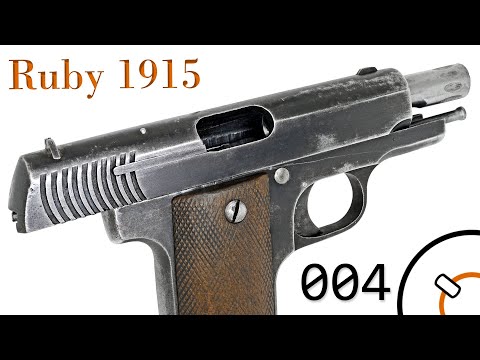
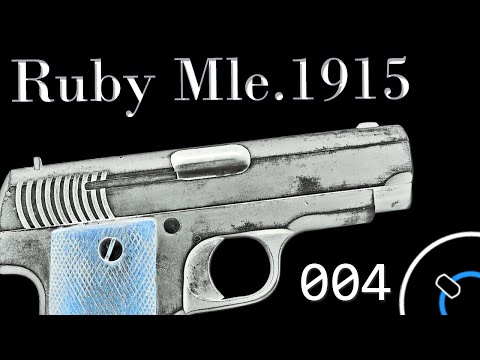
This video delves into the mechanics of the French Mle.1915 "Ruby" pistol, a single-action firearm featuring an internal hammer, slide operation, and blowback action. It highlights the pistol's 9-round detachable box magazine. The content is part of a "WWI Primer" series, suggesting historical context and an educational focus on firearms from that era. Support links for Patreon and SubscribeStar are provided, along with music credit.
This video examines a Spanish-made copy of the Savage automatic pistol, produced in the Eibar region known for its pistol manufacturing during WWI and the Spanish Civil War. While externally resembling the Savage, the internal mechanism is a simple blowback design similar to the Ruby pistols, rather than the Savage's semi-locked rotating barrel system. Key visual cues like slide serrations, barrel jacket, and safety lever are highlighted as attempts to mimic the original Savage.
This guide details the disassembly of the supersized Plus Ultra pistol, a variant of the WWI-era Ruby pistol. Expert Ian McCollum demonstrates the process, highlighting its simple blowback action and unique fluted barrel. The information is presented with high authority, suitable for intermediate enthusiasts interested in historical firearm mechanics.
Gun Laws by State
Read firearms regulations for all 50 states + D.C.
Find Gun Dealers
Search licensed FFL dealers near you.