This video showcases a World War One-era Colt M1911 pistol being fired with a suppressor. The description delves into the history and technical specifications of the M1911 and its M1911A1 variant, highlighting its design by John Browning and its adoption by the U.S. military. It also mentions its widespread influence on pistol operating systems. The video title specifically emphasizes the suppressed firing capability and a first-person perspective.
This video features a Point-of-View (POV) firing demonstration of a World War One era Colt M1911 pistol. The description provides a detailed history and technical overview of the M1911 and its successor, the M1911A1, highlighting John Browning's design and the pistol's influence on semi-automatic firearm development. It covers its formal U.S. military designations and its chambering in .45 ACP.
This video by Ian McCollum of Forgotten Weapons ranks the top 5 pistols of World War One, focusing on locked-breech combat designs from an experienced user's perspective. The Colt M1911 takes the top spot, followed by the Luger P08, Webley M1913, Steyr-Hahn M1912, and Roth-Steyr M1907, with the Ruby pistol receiving an honorable mention. The analysis highlights mechanical features, reliability, and combat effectiveness of each firearm.
This entry details the Mannlicher 88/95, a rare World War One update of older Steyr Mannlicher rifles. Expert Ian McCollum highlights its evolution from earlier models, its distinctive wedge-locking action, and identification features like the 1895 pattern rear sight. The entry also covers provenance, such as 'AOI' markings indicating service in Italian East Africa, and emphasizes the rarity of this specific variant, making it highly sought after by collectors.
The Marlin Model 1917 (7MG) is a WWI aircraft machine gun based on John Browning's Model 1895, redesigned by Carl Gustaf Swebilius for aircraft use. It features a straight-acting gas piston, a tilting bolt, and a unique synchronizer mount for firing through propellers. Early models had extraction issues resolved by adding weight to the gas piston. Its belts have distinct cartridge spacing, making them non-interchangeable with later designs.
This video explores the Galilean optical sight, an early WWI British attempt to improve rifle accuracy. It details the sight's design, its origin in competition shooting at Bisley, and its limited adoption by the British military due to practical drawbacks compared to telescopic sights. The video highlights the scarcity and value of surviving examples.
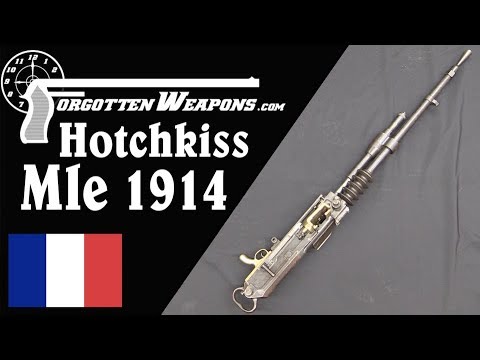
The Hotchkiss 1914 heavy machine gun was a crucial firearm for the French Army in WWI, known for its robust air-cooling system featuring distinctive barrel rings. Developed from an 1890s patent, its design was refined to circumvent existing patents, leading to successful international sales. Key modifications for the 1914 model included a simplified barrel removal and a D-ring handle, distinguishing it from earlier versions.
This "outtakes" episode of Project Lightening offers a humorous behind-the-scenes look at filming historical machine guns. It highlights the challenges of operating WWI-era firearms like the Chauchat and BAR, dealing with range logistics, and the physical demands of handling heavy weapons such as the MG08/15. The episode also includes lighthearted studio banter about historical attire and the realities of long filming days.
This episode of Project Lightening tests WWI-era light machine guns for the 'walking fire' tactic. The Chauchat (both 8mm and .30-06) and the Madsen 1914 proved to be the most effective due to their portability and ergonomics. Heavier guns like the Hotchkiss, Lewis, and MG 08/15 struggled with weight and balance for this specific role. The B.A.R. was designed for the concept but proved difficult to control from the hip.
This entry details the British World War One SMLE sniper rifle, focusing on its development due to German sniping effectiveness. It covers early scope configurations, mount types, and the limitations of early optical technology. The information is presented with high authority by Ian McCollum, highlighting detailed historical and technical knowledge.
This American Rifleman TV series preview focuses on the U.S. involvement in World War I. The eight-part series will explore the historical battlegrounds where American soldiers fought. This initial part sets the stage for a comprehensive look at the American experience during the Great War.
This review of the M1918 BAR highlights its innovative 'walking fire' concept, allowing advancing soldiers to suppress enemies while moving. It details John Browning's design, comparing it favorably to contemporaries like the Chauchat and Lewis gun. The video covers mechanical features, production details, and the weapon's delayed combat introduction due to its advanced design.
Gun Laws by State
Read firearms regulations for all 50 states + D.C.
Find Gun Dealers
Search licensed FFL dealers near you.