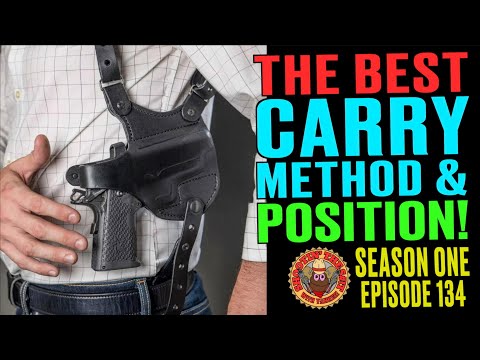
This guide, presented by an experienced practitioner and EDC enthusiast, details why the 'small of the back' or 6 o'clock carry position for a concealed firearm is ill-advised. It highlights key issues including significant printing when bending, awkward and slow draw accessibility, and critical safety concerns like self-flagging and potential spinal injury from falls. The advice emphasizes prioritizing safer and more accessible carry methods.
This video explores the pros and cons of carrying a firearm in the small of the back (6:00) position. While offering excellent concealment and discretion, it presents significant challenges in accessibility, comfort when seated, and drawing speed, especially under pressure. The instructor personally advises against this method due to these drawbacks, emphasizing safety and practical considerations.
The video explores various concealed carry methods, with the host favoring outside waistband carry at the 3:30-4:00 position for comfort and likelihood of carrying. While acknowledging the popularity of inside waistband carry, the host finds it less comfortable. Other methods like fanny pack, shoulder, and pocket carry are discussed with their pros and cons.
The video discusses various pieces of bad tactical advice, highlighting dangerous misconceptions. Key takeaways include the extreme risk of engaging a carjacker while seated, the ineffectiveness and danger of warning shots in most scenarios, and the fallacy that shot placement is unimportant compared to power. It also debunks myths about shotguns being ideal for home defense and the necessity of aiming shotguns, while advocating for carrying a firearm with a round in the chamber for readiness.
This video explores viewer opinions on revolvers and the practice of small of back concealed carry. It directly asks for viewer thoughts, indicating a discussion-based format rather than a product demonstration. While specific firearm models are not mentioned, the topics of revolvers and concealed carry are central.
The Yankee Marshal identifies ankle carry as the worst method of concealed firearm carry due to its extreme difficulty in access during a physical altercation and the high risk of an assailant gaining control of the weapon. While acknowledging appendix and small of back carry have risks, he argues they are manageable with responsible choices, unlike ankle carry which presents inherent vulnerabilities.
This guide, informed by Active Self Protection hosts John Correia and Neil Weidner, focuses on improving concealed carry draw speed. It emphasizes consistent practice with actual carry gear, understanding draw-to-first-shot time standards (expert: 1.0s, professional: 1.5s), and the importance of dry fire drills to maintain proficiency. The analysis highlights how slow draws, particularly from less accessible positions like small-of-back, can have fatal consequences.
This video demonstrates a critical self-defense scenario where a Texas pawn shop owner successfully deters armed robbers. The owner, exhibiting remarkable composure under fire, draws his semi-automatic handgun from a small-of-back holster and fires a warning shot, causing the assailants to flee. The analysis highlights the importance of preparedness and tactical response in high-stress situations.
This video by The Yankee Marshal discusses the safety of Small of Back (SOB) carry compared to Appendix carry. It highlights that SOB carry is generally safer than appendix carry because it avoids pointing the firearm at sensitive areas. The primary risk of SOB carry is spinal injury from falls, which can be mitigated by using larger, flatter semi-automatic handguns instead of small revolvers. Proper draw technique is crucial to avoid flagging oneself.
This video provides a comprehensive overview of common concealed carry positions, focusing on Appendix, 3 O'Clock, and 4 O'Clock carries. The instructor, experienced in firearms instruction, details the pros and cons of each position regarding draw speed, concealability, and comfort. He strongly advises against small of back carry due to safety and tactical disadvantages. The content is geared towards new shooters seeking practical advice on how to carry a firearm effectively and safely.
The speaker details their choice of the Sig P365 for everyday concealed carry, highlighting its comfortable feel, manageable recoil, and effective night sights. They emphasize a personal evolution in self-defense outlook, now prioritizing the protection of loved ones. The video also touches on the importance of scenario-based training and mentions carrying a Kershaw knife as a last resort.
This guide details a comparative analysis of holster carry positions (appendix, kidney, small of the back) for larger individuals, as presented by the 'Overweight Operator' series. It emphasizes evaluating comfort, concealability (printing), and draw speed across various holsters, offering practical recommendations for everyday carry. The insights are derived from experienced firearms instructors and retailers.
Gun Laws by State
Read firearms regulations for all 50 states + D.C.
Find Gun Dealers
Search licensed FFL dealers near you.