This review of an original WW2 StG-44, also known as the MP-44, highlights its status as the world's first assault rifle. The expert enthusiast demonstrates its operation in both semi-automatic and full-automatic modes on an outdoor range, chambered in the original 8mm Kurz caliber. The video showcases the rifle's stamped steel construction and wooden furniture, emphasizing its historical significance and performance.
This entry details the MKb-42(W), a significant early Sturmgewehr prototype developed by Walther. It covers its unique gas-operated system, stamped sheet metal construction, and distinct safety/selector controls. Expert analysis highlights Walther's manufacturing prowess and the historical context of its development.
This Q&A video from Forgotten Weapons delves into the extreme rarity of the German Vampir (Zielgerät 1229) night sight, with an estimated production of only 200 units. Host Ian McCollum highlights that despite extensive museum visits, he has never personally encountered one. He actively seeks information from viewers regarding any known surviving examples in the United States for potential documentation.
This guide details the unique safety mechanism of the MKb42(H), as explained by Ian McCollum. It highlights how the bolt handle itself serves as the safety by locking into a notch. The video also provides a historical context for this early "Sturmgewehr" design, contrasting it with contemporary firearms.
This video details the innovative, largely CNC-free manufacturing process for the JLC-24 rifle, designed by Justin and presented by Mark Serbu. It highlights the use of CAD, 3D printed router guides, laser-cut steel, and manual milling to create a functional firearm inspired by the Sturmgewehr. The process emphasizes accessible fabrication techniques for advanced DIY gunsmiths.
This guide details the process of mounting optics like the ZF4 or ZF41 onto a Sturmgewehr platform, emphasizing the historical rarity of factory mounts and the performance issues encountered during testing. It highlights the importance of a secure mount and the potential for zero loss, especially after sustained fire. Instruction is provided by Ian McCollum, a recognized expert in historical firearms.
This YouTube video features an estate collection tour with a focus on a DShK heavy machine gun. The presenter highlights a variety of firearms, including a milled AK-47, Sturmgewehr, AR70, AMD-65, Galil ARM, Chinese Type 56-1, and a Tula RPK. The video also touches upon a story about some firearms being almost destroyed and welded as display pieces. Merch promotions and discount codes for various firearm-related accessories and brands are included. The content is presented in a casual, engaging style, suitable for firearms enthusiasts interested in rare and varied collections.
This video from PSA discusses 5.56 AK platforms and features a segment on the Sturmgewehr at Shot Show 2023. The creator emphasizes that no firearms are sold through social media and all demonstrations occur on a closed range with supervision. The content is presented for review and entertainment. The description includes extensive disclaimers regarding YouTube's policies on firearm sales and prohibited accessories, reiterating that the video is for documentary, educational, and entertainment purposes only, and adherence to all laws is the viewer's responsibility. Affiliate links are also disclosed.
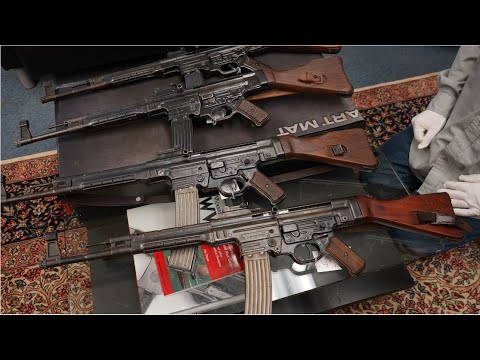
This video showcases four World War II era Sturmgewehr rifles, offering a rare opportunity to see these historical firearms together. As a bonus, an MP40 submachine gun is also featured. The video promotes the creator's Patreon for early access and monthly raffles, as well as their "Flak & Fubar" podcast and Twitter presence. It focuses on the visual presentation and collection of these significant military arms.
This unboxing video showcases a Sturmgewehr (StG 44) replica movie prop from Legacy Collectibles. Despite initial concerns about a damaged shipping box and the prop appearing disassembled, the speaker confirms it's a non-firing replica that simply needs to be put back together. The video highlights the process of unboxing and identifying the prop for its intended use in film production.
This video, presented by Navy SEAL 'Coch' from Tactical Hive, clarifies the meaning of 'AR' in AR-15 as 'ArmaLite Rifle' and defines what constitutes an 'assault rifle'. It traces the origins of the AR platform back to ArmaLite and Eugene Stoner, highlighting the development of early models like the AR-5 and AR-10. The instructor differentiates between military assault rifles (select-fire, intermediate cartridge) and semi-automatic civilian firearms like the AR-15, debunking common misconceptions used in political discourse.
This video showcases the iconic STG-44, also known as the MP-44 or MP-43, highlighting its significance in WWII history. It features a unique demonstration of eight STG-44s firing simultaneously, simulating a battle scenario. The content also includes comparisons of the STG-44 against other notable WWII firearms such as the M1 Garand, M1A1 Thompson, MP-40, PPSH-43, and PPSH-41. The video aims to demonstrate the STG-44's effectiveness and potential as one of the best firearms of its era, appealing to history buffs and firearm enthusiasts.
Gun Laws by State
Read firearms regulations for all 50 states + D.C.
Find Gun Dealers
Search licensed FFL dealers near you.