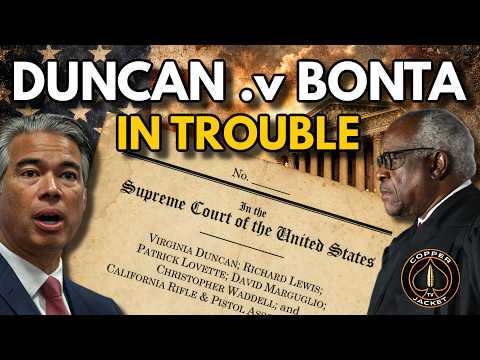
Duncan v. Bonta: How California Is Redefining “Dangerous”

Published on December 12, 2025
Duration: 1:23

This video discusses the legal interpretation of firearm rights, specifically focusing on the Supreme Court's rulings in Bruin and Heller. It highlights the distinction between 'dangerous and unusual' firearms and those that are simply 'dangerous,' as argued in the Duncan v. Bonta case. The discussion emphasizes that the founders' focus was on banning unusually dangerous arms, not all dangerous arms.

Quick Summary

The Supreme Court's rulings in Bruin and Heller indicate that historical firearm bans focused on weapons that were 'unusually dangerous and unusual.' The Duncan v. Bonta case challenges this by arguing that a firearm only needs to be 'dangerous' for restriction, potentially broadening the scope of regulated arms.

Chapters

  1. 00:00Introduction to Duncan v. Bonta Case
  2. 00:15Legal Arguments: Bruin and Heller
  3. 00:24Founders' Focus: Dangerous and Unusual Arms
  4. 00:32Defining 'Unusually Dangerous'
  5. 00:43Examples of Unusual Firearms
  6. 00:51California's Argument: Just 'Dangerous'
  7. 00:56Common Use vs. Protected Arms
  8. 01:07Marksmanship and Protected Conduct
  9. 01:19Right to Keep Arms and Marksmanship

Frequently Asked Questions

What was the founders' primary concern regarding firearm bans, according to Supreme Court rulings like Heller and Bruin?

The founders' focus was on banning firearms that were 'unusually dangerous and unusual.' This implies a high standard for restriction, targeting weapons that are both exceptionally hazardous and not commonly possessed or used for lawful purposes.

How does the Duncan v. Bonta case challenge the interpretation of 'dangerous and unusual' firearms?

In Duncan v. Bonta, California is arguing that a firearm only needs to be 'dangerous' to be restricted, rather than meeting the higher 'dangerous and unusual' standard established by the Supreme Court. This redefinition could broaden the scope of regulated firearms.

Are firearms used for marksmanship protected under the Second Amendment, even if not in common use?

Yes, firearms used for marksmanship are protected. The Second Amendment protects the conduct of marksmanship, meaning even high-precision rifles owned by few individuals are considered protected arms because they facilitate this lawful activity.

Related News

All News →

More 2nd Amendment & Law Videos You Might Like

More from CRPA TV

View all →