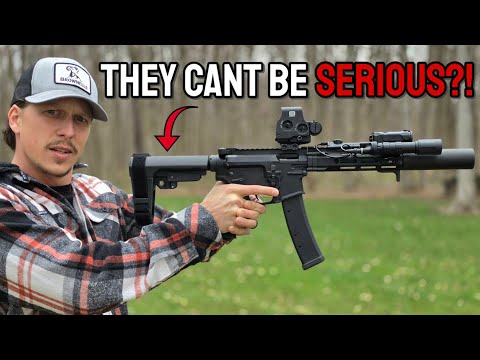
Everything You're NOT Supposed to know about Short Barreled Rifles

Published on January 12, 2026
Duration: 37:15

This video provides a critical examination of the National Firearms Act (NFA) concerning Short Barreled Rifles (SBRs) and Short Barreled Shotguns (SBSs). It details the historical context of the NFA's creation during Prohibition, its original intent, and how subsequent amendments and interpretations have created complex legal landscapes. The speaker, Lucas Botkin of T.REX ARMS, argues the NFA's restrictions are illogical and highlights the human cost of its enforcement, advocating for its repeal.

Quick Summary

The National Firearms Act (NFA) defines Short Barreled Rifles (SBRs) as having barrels under 16 inches and Short Barreled Shotguns (SBSs) with barrels under 18 inches. Originally intended to ban handguns during Prohibition, the NFA's $200 tax stamp (equivalent to thousands today) acts as a significant barrier. The ATF's evolving interpretations, particularly regarding pistol braces, have created complex legal challenges for firearm owners.

Chapters

  1. 00:00Introduction to SBRs & NFA
  2. 03:22Historical Context: Prohibition & NFA
  3. 04:18Original Intent of the NFA
  4. 06:25The $200 Tax Stamp as a Ban
  5. 08:37Post-WWII Barrel Length Changes
  6. 09:36Arbitrary Classifications: AOW & Shotguns
  7. 13:15Historical Exceptions & Legal Traps
  8. 19:31The Pistol Brace Saga
  9. 23:34Current Legal Battles & Advocacy
  10. 27:33The Human Cost of NFA Enforcement

Frequently Asked Questions

What defines a Short Barreled Rifle (SBR) under the NFA?

Under the National Firearms Act (NFA), an SBR is defined as a rifle with a barrel less than 16 inches in length, or a rifle with an overall length of less than 26 inches. Possession requires registration and a $200 tax stamp.

What was the original purpose of the National Firearms Act (NFA)?

The NFA was enacted in 1934 during the Prohibition era. Initially, it was intended to ban handguns, with SBRs and SBSs included to prevent circumvention. When the handgun ban was dropped, SBR/SBS restrictions remained.

How does the NFA tax stamp function as a barrier?

The original $200 NFA tax stamp in 1934 is equivalent to thousands of dollars today. This significant financial burden was designed to act as a de facto ban for most citizens, limiting access to regulated firearms.

What is the significance of the pistol brace in NFA law?

The pistol stabilizing brace created a legal gray area. The ATF's inconsistent rulings on whether attaching a brace to the shoulder constituted 're-manufacturing' a pistol into an SBR led to widespread confusion and legal challenges.

Related News

All News →

More 2nd Amendment & Law Videos You Might Like

More from T.REX ARMS

View all →