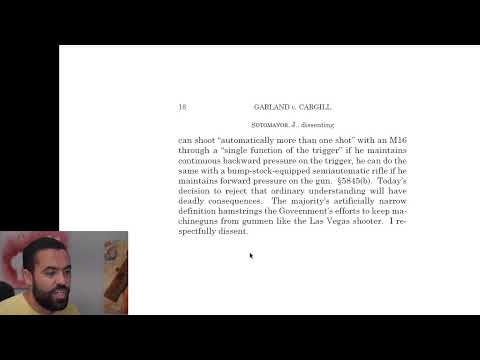
Supreme Court Oral Arguments on Bump Stocks

Published on February 29, 2024
Duration: 142:54

This video covers the Supreme Court oral arguments in Garland v. Cargill, focusing on the definition of a machine gun under federal law and the ATF's regulation of bump stocks. The discussion highlights the legal arguments surrounding the interpretation of the National Firearms Act, the role of executive action versus legislation, and the potential impact on gun rights. The speaker, an instructor, provides context on the historical and technical aspects of firearms regulation.

Quick Summary

The Supreme Court case Garland v. Cargill examines whether bump stocks classify as 'machine guns' under federal law. The core debate revolves around the interpretation of 'single function of the trigger' and 'automatically,' with arguments focusing on the shooter's actions versus the trigger's mechanical operation and the historical context of the NFA.

Chapters

  1. 00:01Introduction: Live Stream Setup
  2. 01:53Court Schedule and Case Identification
  3. 04:23Background of the Bump Stock Ban
  4. 07:15Importance of the Bump Stock Case
  5. 08:07Legal Precedent and Statutory Interpretation
  6. 10:33Discussion on Matt Hoover Case
  7. 12:14State vs. Federal Machine Gun Definitions
  8. 14:30Possibility of Gutting the NFA
  9. 19:23Bruin Decision and Future Precedents
  10. 21:38Waiting for Oral Arguments to Begin
  11. 26:48Oral Arguments Begin: Garland v. Cargill
  12. 26:55Government's Argument on Bump Stock Function
  13. 33:09Justice Barrett's Questions on Bump Firing
  14. 36:35Justice Sotomayor's Questions on Classification
  15. 40:45Justice Thomas's Concerns on Retroactivity and Rulemaking
  16. 43:22Government's Response on Prosecution and Statute of Limitations
  17. 44:49Justice Alito's Question on Trigger Function
  18. 48:47Justice Gorsuch's Question on Common Usage
  19. 55:48Justice Kagan's Question on Rate of Fire
  20. 57:32Justice Kavanaugh's Question on Historical Context
  21. 59:59Government's Explanation of ATF's Position History
  22. 60:59Justice Jackson's Question on Trigger Functionality
  23. 62:33Respondent's Argument: Cargill's Counsel
  24. 64:45Respondent's Argument on Statutory Ambiguity
  25. 66:33Justice Thomas's Question on 'Function' Definition
  26. 68:17Justice Jackson's Question on Classification Rationale
  27. 70:14Respondent's Argument on 1934 Statute Context

Frequently Asked Questions

What is the main legal issue in the Supreme Court case Garland v. Cargill regarding bump stocks?

The central issue is whether bump stocks transform a semi-automatic rifle into a 'machine gun' as defined by federal law, specifically focusing on the interpretation of 'single function of the trigger' and 'automatically.'

How does the ATF's regulation of bump stocks differ from traditional legislation?

The ATF issued an interpretive rule to ban bump stocks, which is distinct from a legislative rule. This distinction impacts how the ban can be challenged and raises questions about whether it constitutes 'executive fiat' bypassing Congress.

What is the historical context of the National Firearms Act (NFA) and its relevance to bump stocks?

The NFA was enacted in 1934 to regulate specific firearms of that era. The debate involves whether its language, particularly 'function of the trigger,' can be applied to modern accessories like bump stocks that did not exist then.

What are the arguments regarding the 'function of the trigger' in the bump stock debate?

Proponents of the ban argue 'function' relates to the shooter's action causing multiple shots. Opponents contend 'function' refers to the trigger's mechanical operation, and that bump stocks require continuous manual input, thus not meeting the 'single function' criteria.

Related News

All News →

More 2nd Amendment & Law Videos You Might Like

More from The VSO Gun Channel

View all →