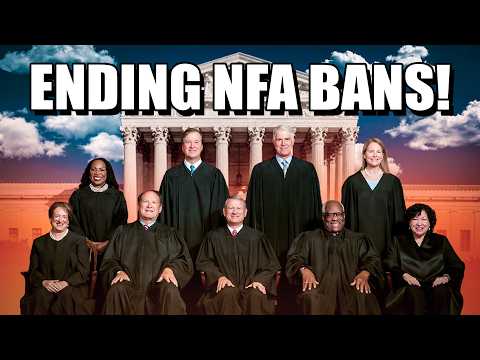
We Can FINALLY Defeat the NFA...

Published on November 18, 2022
Duration: 34:18

This video outlines a strategic, incremental approach to challenging the National Firearms Act of 1934. It proposes leveraging Supreme Court decisions to protect commonly owned semi-automatic firearms and standard-capacity magazines, while also advocating for legislative removal of suppressors from NFA regulation. The analysis delves into potential legal challenges against Short-Barreled Rifles and the Hughes Amendment, highlighting the significance of Justice Samuel Alito's past dissent on machine gun bans. The speaker emphasizes the importance of chipping away at NFA restrictions through a series of legal and legislative actions rather than a single frontal assault.

Quick Summary

The National Firearms Act (NFA) of 1934 regulates specific firearms like machine guns and silencers via a tax stamp. Strategies to challenge it include securing Supreme Court rulings on commonly possessed firearms, legislative removal of suppressors, and legal challenges to SBR regulations, leveraging precedents like 'Heller' and dissenting opinions on machine gun bans.

Chapters

  1. 00:00Introduction: Attacking the NFA
  2. 00:30Host Introduction & Channel Plug
  3. 01:16Understanding the National Firearms Act (NFA)
  4. 03:08Strategic, Incremental Approach
  5. 05:26Step 1: Supreme Court on AR-15s & Magazines
  6. 07:53Step 2: Shrinking ATF Authority
  7. 09:15West Virginia v. EPA Precedent
  8. 09:43Cargill v. Garland & Bump Stocks
  9. 11:53The Chevron Doctrine
  10. 13:22Step 3: Legislation for Suppressors
  11. 15:25Suppressors as Hearing Protection
  12. 17:11Step 4: Lawsuits on Short-Barreled Rifles (SBRs)
  13. 20:02Step 5: Challenging Machine Gun Bans (Hughes Amendment)
  14. 21:06Sonzinski v. United States
  15. 24:04United States v. Rybar & Justice Alito
  16. 28:38Step 6: Taxing Constitutionally Protected Items
  17. 31:29Step 7: Evolving Supreme Court Views on NFA Items
  18. 33:26Conclusion: Incremental Change

Frequently Asked Questions

What is the National Firearms Act (NFA) of 1934?

The NFA is a U.S. federal law enacted in 1934 that regulates specific firearms like machine guns, silencers, short-barreled rifles, and short-barreled shotguns. It imposes a tax stamp requirement for ownership of these items, a regulation upheld by the Supreme Court based on Congress's taxing authority.

How can the Hughes Amendment banning new machine guns be challenged?

The Hughes Amendment of 1986, which banned new machine guns for civilian sale, can be challenged by bringing cases to the Supreme Court. This strategy leverages dissenting opinions, like Justice Samuel Alito's in 'United States v. Rybar', which questioned Congress's authority to enact such a ban.

What is the proposed strategy for challenging Short-Barreled Rifles (SBRs) under the NFA?

The strategy involves arguing that if handguns and long guns are protected Second Amendment arms, then firearms that fall in size between them, like SBRs, should also be protected. This legal approach aims to establish SBRs as constitutionally protected arms.

Can taxes on constitutionally protected items be challenged?

While taxes targeting specific constitutionally protected rights are generally unconstitutional (e.g., poll taxes), the NFA tax on items like machine guns has been upheld because the Supreme Court currently views these items as 'dangerous and unusual weapons' not protected by the Second Amendment.

Related News

All News →

More 2nd Amendment & Law Videos You Might Like

More from The Four Boxes Diner

View all →