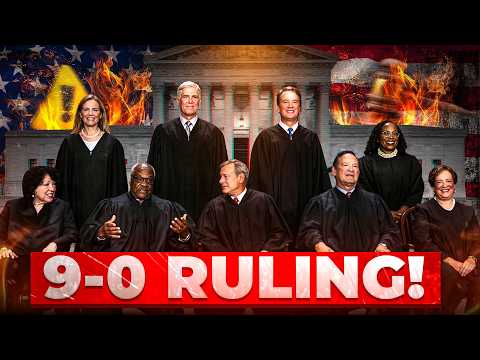
What the Supreme Court Tariff Ruling Really Says

Published on February 20, 2026
Duration: 12:26

This video provides an expert analysis from William Kirk of Washington Gun Law on the Supreme Court's ruling concerning the President's authority to impose tariffs. Kirk breaks down the decision, emphasizing its implications for the separation of powers and the limits on executive authority, particularly in relation to the Major Question Doctrine and the International Emergency Economic Powers Act (IEEPA). The explanation highlights the importance of clear congressional authorization for significant executive actions.

Quick Summary

The Supreme Court ruled that President Trump exceeded his authority by imposing tariffs under the International Emergency Economic Powers Act (IEEPA), emphasizing the need for clear congressional authorization for actions of vast economic significance, as per the Major Question Doctrine. The decision reinforces that the power to impose tariffs rests with Congress.

Chapters

  1. 00:00Introduction to Supreme Court tariff ruling
  2. 00:36Overview of the Supreme Court ruling
  3. 01:25Breakdown of concurring and dissenting opinions
  4. 02:11Ruling about constitutional structure
  5. 02:23Constitutional basis for congressional taxing power
  6. 02:36Government Attorney connection to constitution
  7. 03:00Delegation of taxing authority
  8. 03:23Lack of clear congressional delegation
  9. 03:59Historical precedent and the IEEPA
  10. 04:22The Major Question Doctrine
  11. 05:05Relevance of the Major Questions Doctrine
  12. 05:22Statutory and Constitutional Authority
  13. 06:00Inclusio Unius est Exclusio Alterius
  14. 06:23IEEPA powers lack tariff authority
  15. 06:57Simple English versus political interpretation
  16. 07:28Statutory authority and constitional authority
  17. 08:26Gorsuch concurrence on legislative process
  18. 08:44Justice Gorsuch's tempering language
  19. 09:21Tapping into Wisdom of Legislators
  20. 10:05A check on presidential power

Frequently Asked Questions

What did the Supreme Court rule regarding President Trump's tariffs under IEEPA?

The Supreme Court ruled 6-3 that President Trump exceeded his authority by imposing billions of dollars in tariffs under the International Emergency Economic Powers Act (IEEPA). The decision focused on the lack of clear congressional authorization for such actions, emphasizing the separation of powers.

What is the Major Question Doctrine and how does it apply to the tariff ruling?

The Major Question Doctrine is a Supreme Court principle requiring explicit congressional authorization for federal agencies or the President to act on issues of vast economic or political significance. In the tariff case, it meant the President needed clear statutory power from Congress to impose tariffs, which was found lacking in IEEPA.

Why is the distinction between Congressional and Presidential power important in the tariff ruling?

The ruling highlights that the power to impose tariffs is a core part of the taxing power, constitutionally vested in Congress. The Court found that IEEPA did not grant the President this specific, extraordinary power, reinforcing the separation of powers and the need for clear legislative delegation.

What does the principle 'Inclusio Unius est Exclusio Alterius' mean in the context of the IEEPA ruling?

This Latin principle means 'the inclusion of one thing means the exclusion of all others.' In the tariff case, it meant that because IEEPA listed specific powers for the President (like regulating imports/exports) but did not mention tariffs, the power to impose tariffs was implicitly excluded.

Related News

All News →

More 2nd Amendment & Law Videos You Might Like

More from Washington Gun Law

View all →