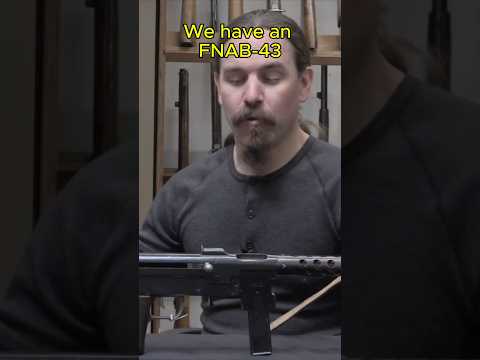
Sten MkIII: A Children's Toy Company Makes SMGs

Published on June 5, 2024
Duration: 13:11

This entry details the Sten MkIII submachine gun, focusing on its simplified production by Lines Limited, a toy company, during WWII. It highlights manufacturing techniques like spot welding and tension-fit components, contrasting it with the MkII. Expert instruction from Ian McCollum covers the proper firing stance, emphasizing grip on the barrel shroud and the function of the hand stop. The entry also touches on production numbers and distribution differences between the MkII and MkIII.

Quick Summary

The Sten MkIII submachine gun, produced by the British toy company Lines Limited, was a simplified version designed for rapid wartime manufacturing using stamped sheet metal and spot welding. Expert Ian McCollum highlights its unique construction, including a permanently mounted barrel and a tension-fit receiver cover, and demonstrates the correct firing stance emphasizing grip on the barrel shroud.

Chapters

  1. 00:00Introduction to Sten MkIII
  2. 01:31Mass Production Contracts
  3. 02:16Simplified Manufacturing Techniques
  4. 03:36Design Comparison: MkII vs MkIII
  5. 07:08Proper Handling and Firing Stance
  6. 08:57Evaluation and Distribution Comparison
  7. 11:06Production Conclusion

Frequently Asked Questions

Who manufactured the Sten MkIII submachine gun?

The Sten MkIII submachine gun was famously manufactured by Lines Limited, a British company that transitioned from making toys to producing firearms to aid the war effort during World War II.

What were the key manufacturing differences between the Sten MkII and MkIII?

The Sten MkIII featured a simplified, fully stamped sheet metal receiver made from rolled steel tubes spot-welded together, and had a permanently mounted barrel, unlike the MkII's removable barrel system.

How did the British Army recommend firing the Sten submachine gun?

The British Army's prescribed method for firing the Sten involved gripping the barrel shroud for stability and control, rather than holding the magazine or magazine well, to prevent interference with operation.

Why was the Sten MkII ultimately preferred over the MkIII for certain roles?

Despite the MkIII's faster production rate, the MkII was often considered superior due to better quality control and repairability, leading to its prioritization for overseas service while MkIIIs were frequently issued to the Home Guard.

More Gunsmithing & DIY Videos You Might Like

More from Forgotten Weapons

View all →