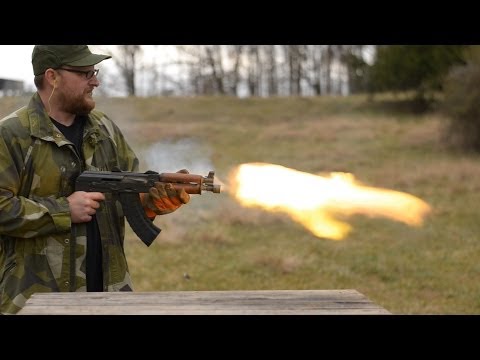
What is a Brush Gun?

Published on December 1, 2016
Duration: 17:15

This video from Iraqveteran8888, featuring expert Eric, debunks the myth of using high-velocity spitzer bullets for hunting in brush. Through practical testing, the video demonstrates how heavy, slow-moving, round-nose bullets like the .45-70 Government and .444 Marlin significantly outperform smaller, faster rounds when encountering vegetation, maintaining accuracy and penetration.

Quick Summary

Expert testing confirms that heavy, slow-moving, round-nose bullets (.45-70 Government, .444 Marlin) are superior for hunting in dense brush. High-velocity spitzer rounds (.308 Win, 5.56 NATO) deflect easily off branches, causing keyholing and inaccuracy, while larger, heavier projectiles maintain stability and penetration.

Chapters

  1. 00:00Defining the Brush Gun
  2. 01:53.22 LR Baseline Test
  3. 03:30High-Velocity Spitzer Bullets
  4. 07:33.35 Remington Performance
  5. 10:10Heavy Calibers: .444 Marlin and .45-70
  6. 14:58Extreme Mass: .577 Snider

Frequently Asked Questions

What makes a rifle a 'brush gun'?

A brush gun is typically a large-caliber lever-action rifle, such as those chambered in .45-70 Government or .444 Marlin. They are designed for hunting in dense vegetation where heavy, slow-moving bullets are more effective than high-velocity rounds.

Do high-velocity bullets perform poorly in brush?

Yes, high-velocity spitzer bullets, like 5.56 NATO or .308 Winchester, tend to deflect significantly when hitting branches. This instability causes keyholing and inaccuracy, making them unsuitable for shooting through dense cover.

Which calibers are best for hunting in brush?

Calibers like .45-70 Government and .444 Marlin, which fire heavy, slow-moving, round-nose bullets, are ideal for brush hunting. Even extremely massive bullets like the .577 Snider can penetrate brush effectively at low velocities.

What is keyholing in shooting?

Keyholing occurs when a bullet loses stability in flight and strikes the target sideways, creating an oval-shaped hole resembling a keyhole. This is often caused by bullet tumbling due to deflection from obstacles like brush.

Related News

All News →

More Hunting & Outdoors Videos You Might Like

More from Iraqveteran8888

View all →