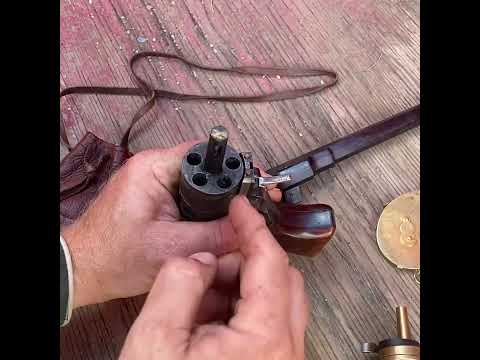
1860 Colt vs Cartridge Conversion

Published on July 16, 2020
Duration: 17:27

This guide details a reliability test comparing a Pietta 1860 Colt Army percussion revolver with an Uberti Richard-Mason Type 2 cartridge conversion. Expert Karl Kasarda emphasizes the reliability of correctly loaded percussion firearms and compares their performance and ballistic characteristics to early cartridge conversions, highlighting the importance of proper black powder loading techniques and safety features.

Quick Summary

Expert Karl Kasarda highlights that correctly loaded 1860 Colt percussion revolvers are highly reliable, achieving ~700 fps with 210-217gr conical bullets, comparable to early .44 Colt cartridges. He notes the 1860 Colt's 6-round safe carry via safety notches, contrasting with early conversions' 5-round capacity, and emphasizes proper black powder loading 'alchemy' for dependability.

Chapters

  1. 00:00Introduction: 1860 Colt & Richard-Mason Conversion
  2. 01:10Backup Gun Match: A Reliability Test
  3. 02:23Black Powder 'Alchemy' & Reliability
  4. 04:39Conical Bullets vs. Round Balls
  5. 06:18Paper Cartridges Explained
  6. 07:39Capacity & Safety Notches
  7. 09:16Performance & Reloading Comparison
  8. 11:37Ballistics & Fouling Control

Frequently Asked Questions

How reliable are 1860 Colt percussion revolvers compared to early cartridge conversions?

Expert Karl Kasarda states that correctly loaded percussion revolvers, like the 1860 Colt, are highly reliable. He notes that their perceived unreliability often stems from modern shooters not understanding proper black powder loading techniques, which are crucial for optimal performance and dependability in the field.

What are the key differences in safety and capacity between a 1860 Colt percussion and a cartridge conversion?

The 1860 Colt percussion revolver features safety notches allowing for a safe 6-round carry. Early cartridge conversions often lacked these, requiring a 5-round carry with the hammer on an empty chamber to ensure safety, thus offering less immediate capacity.

What kind of projectiles were historically used in 1860 Colt revolvers, and how do their ballistics compare to cartridges?

Historically, .44 caliber percussion revolvers like the 1860 Colt primarily used conical projectiles, such as the Johnston & Dow 210-217gr, which provided ballistics nearly identical to later .44 Colt cartridges, achieving velocities around 700 fps.

Can paper cartridges for percussion revolvers be considered logistically similar to metallic cartridges?

Yes, the video suggests that for the average user in the field, carrying paper cartridges for percussion revolvers was logistically very similar to carrying boxes of metallic cartridges for conversion revolvers, making the transition less of a logistical hurdle than often assumed.

More Range & Competition Videos You Might Like

More from InRangeTV

View all →