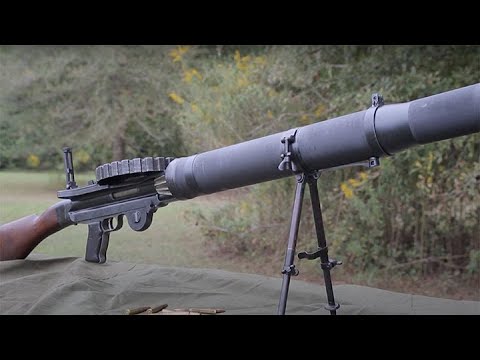
Forward Thinking: Lewis "Assault Phase" Rifle

Published on June 21, 2017
Duration: 9:35

This video provides an in-depth look at Isaac Lewis's "Assault Phase" rifle, a highly advanced firearm for its time. The presenter, an expert in small arms, details its innovative features, compares it to the Browning Automatic Rifle (BAR), and discusses why it was ultimately overlooked by the US military. The rifle showcased is the third design iteration, weighing 12 lbs and chambered in .30-06, featuring a piston-operated system, detachable magazine, ambidextrous controls, and a left-hand charging handle.

Quick Summary

The Lewis "Assault Phase" rifle, developed by Isaac Lewis around 1916-1918, was a highly advanced firearm for its time. It featured a detachable magazine, piston operation, ambidextrous controls, and a left-hand charging handle, making it significantly lighter and potentially more capable than the Browning Automatic Rifle (BAR), yet it was ultimately overlooked by the US military.

Chapters

  1. 00:00Introduction to Isaac Lewis and his work
  2. 00:05The Lewis Machine Gun and its reception
  3. 01:04The Lewis "Assault Phase" Rifle concept
  4. 01:26Advanced features of the rifle
  5. 02:03Comparison with the Browning Automatic Rifle (BAR)
  6. 02:43Buttstock variations and history
  7. 03:26Lewis's rifle vs. the BAR in trials
  8. 04:46Design iterations of the "Assault Phase" Rifle
  9. 05:11Lewis's design philosophy
  10. 06:01Detailed look at the piston system and cooling fins
  11. 06:23Barrel shroud and operation
  12. 06:31Piston system movement and similarity to Lewis pistol
  13. 06:56Open bolt system explanation
  14. 07:08Rear sight design and functionality
  15. 07:22Left-hand charging handle and selector switch
  16. 07:40Ambidextrous magazine release
  17. 07:50Magazine considerations
  18. 08:06Take-down and stock features
  19. 08:16Overall design and role
  20. 08:35Missing features (bipods)
  21. 08:42Conclusion and thanks

Frequently Asked Questions

What made Isaac Lewis's "Assault Phase" rifle so advanced for its time?

The Lewis "Assault Phase" rifle, developed around 1916-1918, featured a detachable magazine, piston operation, ambidextrous controls, a left-hand charging handle, and an angled pistol grip. These innovations were highly advanced, predating similar features in rifles that became common in the 1930s and beyond, making it a revolutionary design for its era.

How did the Lewis "Assault Phase" rifle compare to the Browning Automatic Rifle (BAR)?

The Lewis "Assault Phase" rifle was notably lighter than the BAR, weighing approximately 12 lbs compared to the BAR's 16 lbs. It was also considered potentially superior in accuracy and cooling. Despite these advantages, the BAR was ultimately adopted by the US War Department.

What was the intended purpose of Isaac Lewis's "Assault Phase" rifle?

Isaac Lewis envisioned the "Assault Phase" rifle as a light automatic rifle that soldiers could effectively use in offensive assaults while on the move. He aimed to create a reliable, simply operated weapon that offered automatic capability and was superior to existing infantry rifles like the M1903 Springfield.

What caliber was the Lewis "Assault Phase" rifle chambered in?

The Lewis "Assault Phase" rifle was chambered in .30-06 Springfield. This caliber provided the rifle with long-range capability, fitting its intended role as an advanced infantry weapon.

More Reviews Videos You Might Like

More from TFB TV

View all →