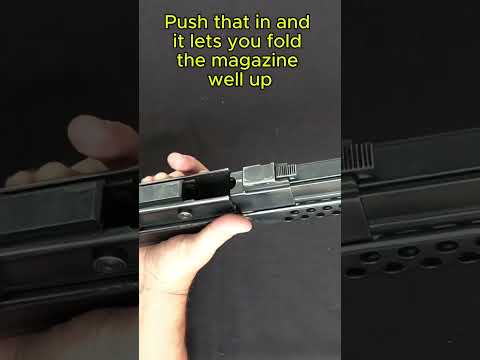
One of a kind 1916 prototype: the Iver Johnson blow-forward 25ACP

Published on May 13, 2026
Duration: 1:10

This video examines a unique 1916 prototype blow-forward .25 ACP pistol from Iver Johnson. The firearm is a one-of-a-kind tool room sample or demonstration model, based on a patent applied for by William O. Barnes in 1912 and granted in 1916. Iver Johnson, known primarily for revolvers, appears to have considered this semi-automatic design but ultimately did not put it into production.


Quick Summary

The 1916 Iver Johnson blow-forward .25 ACP pistol is a unique prototype, possibly a tool room sample. Its design is based on a 1912 patent by William O. Barnes, granted in 1916 and assigned to Iver Johnson. Despite its existence, the company, known for revolvers, never put this semi-automatic design into production.

Chapters

  1. 00:02Introduction to the Prototype
  2. 00:15One-of-a-Kind Status
  3. 00:18Purpose: Tool Room Sample/Demonstration Model
  4. 00:25Iver Johnson Company Context
  5. 00:29Patent Details: William O. Barnes (1912)
  6. 00:36Patent Grant and Assignment (1916)
  7. 00:41Iver Johnson's Historical Production (Revolvers)
  8. 00:49Future Semi-Automatic Handguns
  9. 00:54Considered Project, Never Produced
  10. 01:07Conclusion: Tiny Prototype

Frequently Asked Questions

What is the significance of the 1916 Iver Johnson blow-forward .25 ACP pistol?

This firearm is significant as a one-of-a-kind prototype, likely a tool room sample or demonstration model, from approximately 1916. It represents an early consideration of semi-automatic designs by Iver Johnson, a company primarily known for revolvers.

Who was William O. Barnes and what was his connection to this Iver Johnson prototype?

William O. Barnes of Massachusetts applied for the patent for this blow-forward mechanism in 1912. The patent was granted to him in 1916 and then assigned to the Iver Johnson company, which produced this unique prototype.

Why did Iver Johnson not put the blow-forward .25 ACP pistol into production?

The exact reasons for Iver Johnson not proceeding with production of this blow-forward .25 ACP prototype are not detailed in the video. It is suggested that after creating the one-of-a-kind sample, the company decided it wasn't a viable product for various reasons.

What was Iver Johnson's typical firearm production before semi-automatics?

Historically, Iver Johnson was predominantly known for manufacturing revolvers. They produced both small and large frame revolvers, often emphasizing affordability, and did not venture into semi-automatic handguns until many decades later.

Related News

All News →

More Reviews Videos You Might Like

More from Forgotten Weapons

View all →