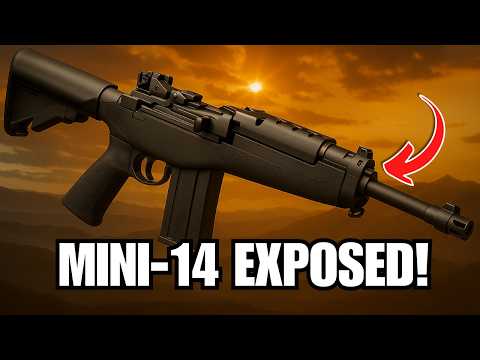
What Ruger Doesn't Want You to Know About the Mini-14

Published on February 20, 2026
Duration: 13:56

This expert guide, drawing on the insights of an experienced firearms instructor, details the history and evolution of the Ruger Mini-14. It covers the rifle's design origins, key mechanical features, and significant variants like the Mini-30 and AC556. The guide also touches upon the Mini-14's historical use, its refinement for improved accuracy, and its enduring appeal in the civilian market, contrasting it with modern platforms.

Quick Summary

The Ruger Mini-14, released in 1973, is a distinct design inspired by the M1 Garand's gas system, not merely a scaled-down M14. Early models had accuracy issues due to thin barrels, but Ruger significantly improved performance around 2003-2007 with heavier barrels and tighter tolerances, achieving sub-2 MOA accuracy.

Chapters

  1. 00:04Mini-14 Under the Ruger Radar
  2. 00:17Mini-14 Overview and Features
  3. 00:50Mini-14 Origin and Reliability
  4. 01:25Mini-14 System and Early Quirks
  5. 02:07Ruger Improvements Over Time
  6. 02:24Mini-14 Mechanical Design
  7. 03:42.222 Mini-14 Variant
  8. 05:20Mini-30 Details, Caliber and Handling
  9. 06:01Mini-30 Market Support and Problems
  10. 06:56Mini-14 Goes to War
  11. 08:07AC556 Details and SWAT Use
  12. 08:51Mini-14 and Infamous Events
  13. 09:04FBI Miami Shootout Details
  14. 09:29Ecole Polytechnique, Anders Breivik
  15. 09:48Nova Scotia Shooter
  16. 10:21Accuracy Fixes
  17. 11:12Refinement and Tolerance Improvements
  18. 11:35Improved Accuracy
  19. 12:00Why the Mini-14 Sells in 2025

Frequently Asked Questions

What is the history behind the Ruger Mini-14?

The Ruger Mini-14 was introduced in 1973, designed by Jim Sullivan and Bill Ruger as a civilian-friendly carbine. It features an M1 Garand-inspired short-stroke gas piston system and a rotating bolt, aiming for reliability and ease of use.

How did Ruger improve the accuracy of the Mini-14?

Around 2003-2007, Ruger implemented significant accuracy improvements by using heavier barrels, shortening the gas port, and machining receivers to tighter tolerances. These changes resulted in sub-2 MOA groupings with factory ammunition.

What are the key differences between the Ruger Mini-14 and Mini-30?

The primary difference is caliber: the Mini-14 is typically chambered in .223 Remington/5.56 NATO, while the Mini-30 is chambered in 7.62x39mm. The Mini-30 also faced challenges with magazine availability and early reliability issues.

Has the Ruger Mini-14 been used by military or law enforcement?

Yes, the Mini-14, particularly the GB model with features like a bayonet lug and flash hider, has been issued to law enforcement agencies, prison units, and military regiments like the Royal Bermuda Regiment for extended periods.

Related News

All News →

More Reviews Videos You Might Like

More from Line45

View all →