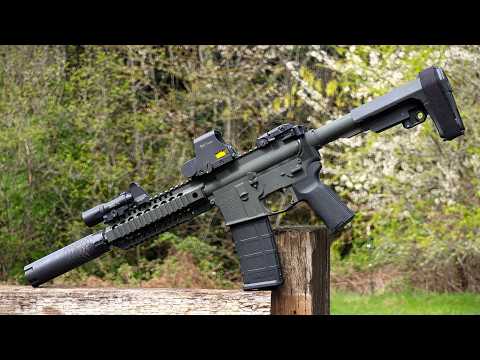
AR vs AK - Moondust Test!

Published on October 17, 2025
Duration: 25:51

This video details a simulated "moon dust" reliability test comparing an AK variant, an AR-15 (BCM), and a PWS rifle with a long-stroke gas piston. The test involves intentionally exposing critical firearm components to fine dust and then firing, assessing performance under adverse conditions. The AK demonstrated slightly superior reliability, while the AR-15's performance was impacted by operator error regarding the forward assist. The PWS also performed well but highlighted the challenges of its operating system without a forward assist.

Quick Summary

The "moon dust" test simulates firearm reliability in dusty environments by exposing critical components to fine sand and dirt. In this test, an AK variant slightly outperformed an AR-15 and a PWS rifle, with the AR-15's performance being impacted by operator error regarding the forward assist.

Chapters

  1. 00:00Introduction: The "Moon Dust" Test
  2. 01:38Test Subject 1: AK Variant (Saiga)
  3. 02:03Test Subject 2: AR-15 (BCM)
  4. 03:01Test Subject 3: PWS Rifle
  5. 04:36Test Procedure Explained
  6. 05:50AK "Moon Dust" Test - Round 1 (Safety On)
  7. 07:00AK "Moon Dust" Test - Round 2 (Safety Off)
  8. 08:31AR-15 "Moon Dust" Test - Round 1 (Port Cover Closed)
  9. 09:55AR-15 "Moon Dust" Test - Round 2 (Port Cover Open)
  10. 12:13Advanced Test: Dropping Bolt/Carrier in Dust
  11. 14:59PWS "Moon Dust" Test - Round 1
  12. 16:36PWS "Moon Dust" Test - Round 2 (Port Cover Open)
  13. 17:41PWS Advanced Test: Dropping Bolt/Carrier in Dust
  14. 21:59Final Performance Ranking & Analysis
  15. 23:11PWS "Hot Garbage" Commentary & Clarification
  16. 24:51Viewer Engagement & Support

Frequently Asked Questions

What is the "moon dust" test for firearms?

The "moon dust" test is a simulated reliability test where firearms are intentionally exposed to a fine, powdery mixture of sand and dirt. This test aims to evaluate how well different firearm designs and operating systems function when critical components are contaminated with abrasive particulate matter.

How did the AK and AR-15 perform in the "moon dust" test?

In the "moon dust" test, the AK variant performed slightly better, demonstrating consistent reliability. The AR-15 experienced a malfunction attributed to operator error (failure to use the forward assist), but functioned correctly when the assist was employed. Both were significantly affected by the dust until cleaned.

What is the purpose of the forward assist on an AR-15?

The forward assist on an AR-15 is a feature designed to manually push the bolt carrier group fully into battery if it fails to seat completely on its own. This is particularly useful in adverse conditions where dirt or debris might impede the bolt's forward travel.

How does a long-stroke gas piston system differ from direct impingement?

A long-stroke gas piston system, like in AKs, uses a piston rod that moves with the bolt carrier, driven by gas. Direct impingement (DI), common in AR-15s, routes gas directly back to the bolt carrier. The long-stroke system is often considered more robust against fouling but can be heavier.

Related News

All News →

More Tactical & Gear Videos You Might Like

More from Military Arms Channel

View all →