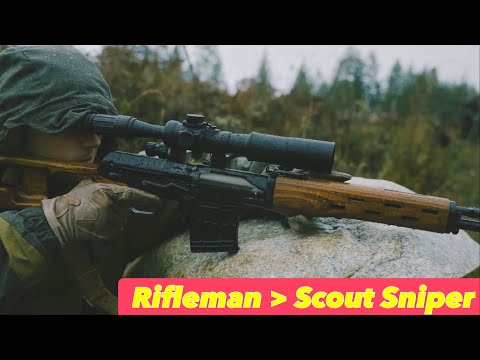
Civilian Sniper Concept for WROL

Published on July 1, 2026
Duration: 20:43

This video details the technical and tactical application of a Special Purpose Rifle (SPR) for civilian resistance operations, focusing on the shooter-coach pair concept. It emphasizes the critical nature of structured fire commands, accurate range estimation, wind calls, and MOA calculations for effective engagement. The instructor highlights the importance of training and communication for a successful designated marksman team in a WROL scenario.

Quick Summary

In a WROL scenario, a civilian designated marksman's primary role is to act as a force multiplier, focusing on observation, intelligence gathering, and selective harassing fire from concealed positions. Effective communication through clear fire commands, accurate range estimation, and understanding MOA for wind calls are crucial for success.

Chapters

  1. 00:00Introduction: Civilian Designated Marksman
  2. 00:18Technical & Tactical Application of SPR
  3. 00:36Scenario: Town Square Hostage Situation
  4. 01:02Shooter-Coach Pair Approach & Setup
  5. 01:27Engagement: Target Acquisition & Fire Commands
  6. 01:56Adjustments & Re-engagement
  7. 02:08Importance of Fire Commands
  8. 02:45Historical Context: Snipers & Guerrilla Warfare
  9. 03:26Modern Application: Force Multiplier Role
  10. 03:52Two Unique Scenarios for SPR Use
  11. 04:28Recommended Firearm Calibers (5.56 vs .308)
  12. 04:46Gas Guns vs. Bolt Guns for WROL
  13. 04:50Caliber Commonality & Carry Capacity
  14. 05:15Optics Recommendations (LPVOs)
  15. 05:40Technical Application: Wind Calls & Holds
  16. 06:31Understanding Target Frames & Corrections
  17. 06:57MOA Math & Wind Holds Explained
  18. 07:35Ballistics: Internal, External, Terminal
  19. 08:05Ballistic Coefficient & Gravity
  20. 08:35Terminal Performance Considerations
  21. 09:05Planning Factors: Recce & Range Estimation
  22. 09:40Environmental Conditions & Camouflage
  23. 10:18Ammunition Carry Capacity Decisions
  24. 10:24Camouflage & Silhouette Management
  25. 10:57Training Priorities: Practice Over Theory
  26. 11:19Training Outweighs Everything
  27. 11:33Educate Yourself for Community & Family
  28. 11:44Conclusion & Community Support

Frequently Asked Questions

What is the primary role of a civilian designated marksman in a WROL scenario?

In a WROL scenario, a civilian designated marksman primarily acts as a force multiplier for a larger group or as a sole operative. Their role involves observation, intelligence gathering, and selective harassing fire from concealed positions, rather than constant engagement.

What are the key components of effective fire commands for a shooter-coach pair?

Effective fire commands require a clear, structured sequence. This includes target identification, precise range, wind value (e.g., quarter, half, full), and specific holds (e.g., 'hold half target frame right'). Both shooter and coach must understand these calls implicitly.

Why are gas-operated firearms preferred over bolt-action rifles for civilian WROL scenarios?

Gas-operated firearms are preferred for their ability to facilitate fast follow-up shots, which is critical in a WROL situation where rapid engagement and disengagement might be necessary. Bolt-action rifles are generally too slow for this purpose.

What is the importance of MOA math in long-range shooting?

MOA math is essential for calculating precise adjustments for windage and elevation at extended ranges. Understanding MOA allows a marksman to accurately compensate for environmental factors and ensure hits on target, especially when using a dope card.

More Training & Techniques Videos You Might Like

More from Trench Grenade

View all →