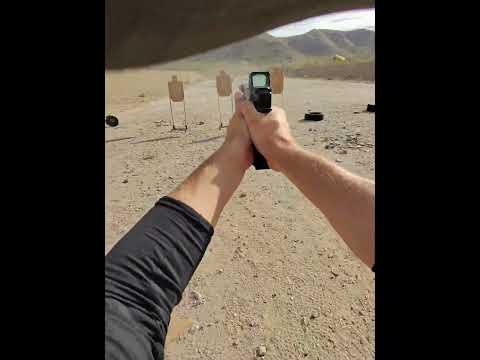
How I Zero My Red Dot On My Pistol

Published on October 21, 2017
Duration: 8:10

This guide details Scott Jedlinski's practical method for zeroing a red dot sight on a pistol, emphasizing a 10-yard initial zero for visibility and practical application. He stresses shooting offhand, verifying at distance, and understanding hold-overs for close targets. Jedlinski, a professional firearms instructor, highlights the importance of a natural shooting position and appropriate red dot brightness for effective zeroing in self-defense and competition scenarios.

Quick Summary

Scott Jedlinski's expert method for zeroing a pistol red dot sight begins at 10 yards, shooting offhand for practical accuracy. He emphasizes verifying the zero at 15 and 25 yards, understanding close-range hold-overs, and adjusting red dot brightness for optimal target visibility. This approach ensures a reliable zero for self-defense and competition.

Chapters

  1. 00:00Introduction to Red Dot Zeroing
  2. 00:45Why Zero at 10 Yards
  3. 01:37The Zeroing Procedure
  4. 02:57Verification at Distance
  5. 04:08Close-Range Holds Explained
  6. 04:52Precision Tips for Zeroing
  7. 05:56Self-Defense and Competition Standards

Frequently Asked Questions

What is the recommended distance for initially zeroing a pistol's red dot sight?

Scott Jedlinski recommends an initial zeroing distance of 10 yards. This distance is chosen for better visibility and to simplify hold-overs when engaging closer targets, which is common in practical shooting scenarios.

Why is shooting offhand important when zeroing a red dot sight?

Shooting offhand, without a rest, is crucial because it replicates how you'll likely be shooting in real-world self-defense or competition. A zero achieved from a rest may not be accurate when shooting from a natural, unsupported stance.

How should red dot brightness be adjusted for optimal zeroing?

Jedlinski advises dimming the red dot sight to enhance target visibility. An overly bright dot can obscure the target or create a bloom effect, hindering precise aiming during the zeroing process.

What is considered an acceptable accuracy standard for self-defense and USPSA?

For self-defense and USPSA, a deviation of up to 1 inch at 25 yards is generally acceptable, as long as the shots consistently land within the center of the target. Precision is key, but practical accuracy is the goal.

Related News

All News →

More Training & Techniques Videos You Might Like

More from Modern Samurai Project

View all →