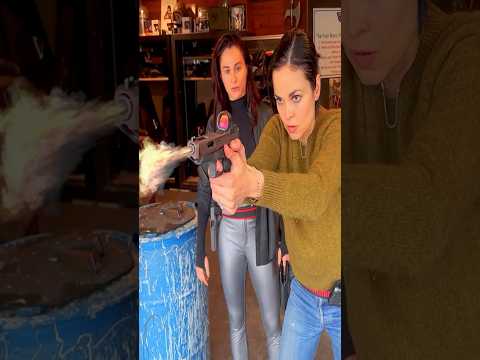
Limp Wrist Test

Published on January 19, 2009
Duration: 1:47

This guide details the procedure for conducting a 'limp wrist' test on semi-automatic pistols, as demonstrated by Military Arms Channel. The test evaluates a firearm's reliability under a compromised grip, highlighting how different models and calibers perform when the shooter's wrist offers minimal resistance to the slide's cycling action. The expert demonstrates how some firearms, like the HK USP Tactical and S&W 5906, maintain reliability, while others, such as the Glock 17 and 21, may experience malfunctions.

Quick Summary

The limp wrist test assesses a semi-automatic pistol's reliability under suboptimal grip conditions. Firearms like the HK USP Tactical and S&W 5906 showed high tolerance, cycling reliably with a loose grip, while Glock 17 and 21 models experienced significant malfunctions, highlighting differences in design and operational tolerances.

Chapters

  1. 00:00Glock 17 Limp Wrist Test
  2. 00:34Glock 21 Limp Wrist Test
  3. 01:01HK USP Tactical Limp Wrist Test
  4. 01:20S&W 5906 Limp Wrist Test

Frequently Asked Questions

What is a limp wrist test in firearms?

A limp wrist test evaluates a semi-automatic pistol's reliability by having the shooter intentionally loosen their grip, allowing the wrist to absorb recoil without resistance. This checks if the firearm can still cycle properly under suboptimal shooting conditions.

Which firearms performed best in the limp wrist test?

In this test, the Heckler & Koch USP Tactical in .45 ACP and the Smith & Wesson 5906 in 9mm demonstrated high reliability, cycling consistently even with a significantly loose grip.

Which firearms struggled with the limp wrist test?

The Glock 17 in 9mm and the Glock 21 in .45 ACP experienced multiple cycling malfunctions, including failures to eject and failures to return to battery, when subjected to a limp wrist grip.

Why is a limp wrist test important for firearm owners?

Understanding how a firearm performs with a compromised grip is crucial for self-defense and tactical situations where perfect shooting form may not be possible. It reveals a firearm's operational tolerances.

Related News

All News →

More Training & Techniques Videos You Might Like

More from Military Arms Channel

View all →