Colion Noir, a high-authority firearms commentator, tests Armored Cyber Glass on a Tesla Cybertruck. The glass, rated NIJ Level IIIA and only 15mm thick, successfully stops various threats including .277 Sig Fury, .308 Win, handgun rounds, and astonishingly, a .50 BMG round. The demonstration highlights the glass's 'return fire' capability and projectile capture technology, impressing Noir with its performance against extreme ballistic threats.
This video provides an expert-level examination of Armitek's ballistic glass, testing its effectiveness against various calibers from 9mm to .50 BMG. The presenter, Mike Jones (Garand Thumb), utilizes high-speed photography to analyze impacts, demonstrating the glass's ability to stop rounds without significant deformation. The testing covers UL Level 6, 7, and 8 ratings, showcasing the material's performance under extreme ballistic stress.
This video provides an in-depth review of the Nemo Arms Nightmare 300 Win Mag Pistol, a compact yet powerful firearm. The presenter, Scott from Kentucky Ballistics, highlights its significant muzzle flash and concussive force, demonstrating its capabilities through various tests including ballistic glass penetration and target destruction. The review emphasizes the importance of understanding suppressor ratings for short-barreled rifles.
This video from Yee Yee Life, featuring Granger Smith, tests the ballistic resistance of a HUMVEE windshield against various calibers. The windshield successfully stopped smaller rounds like .22 LR, 9mm, .45 ACP, and .44 Magnum, showing significant surface damage and deformation. However, high-velocity rifle rounds (.223 Remington) and large shotgun slugs (12-Gauge) penetrated the glass, demonstrating its limitations against more powerful ammunition.
This video demonstrates the ballistic protection capabilities of an OSG Armored Land Cruiser 200 against an M14 rifle firing 7.62x51mm ammunition. The vehicle features polycarbonate ballistic glass, 5mm ballistic plates, run-flat tire inserts, and an armored door with a gun port, showcasing its resistance to direct fire.
This video provides an expert-level demonstration of ballistic testing on a Badlands Armored SUV Conversion, specifically a Toyota Land Cruiser 200 series. The vehicle features Level 6 protection, including advanced armor materials like Dyneema and AR500 steel, and multi-layer ballistic glass. The testing, conducted by Guns Pinoy and Sir Fausto from Badlands Garage, showcases the SUV's resilience against various pistol and rifle calibers, highlighting its robust design and protective capabilities.
This video tests the ballistic resistance of military-grade glass against high-powered firearms. Initially, an M134 Minigun firing 7.62mm rounds from a ground position failed to penetrate the glass. However, after weakening the glass through aerial Minigun fire, an M249 SAW firing 5.56mm rounds was able to penetrate.
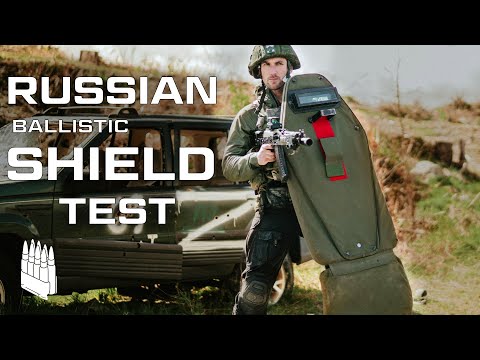
This video provides an expert-level assessment of the Russian VANT ballistic shield by Garand Thumb, a recognized authority in tactical gear. The shield, estimated to weigh 50-100 lbs, is tested against various threats including 9mm NATO, 7.62x39mm, 5.56x45mm, 7.62x51mm, .30-06 AP, and .50 BMG rounds, as well as 12-gauge buckshot. While effective against common rifle rounds and pistol calibers, it is defeated by .30-06 AP and .50 BMG. The visor stops buckshot but shatters internally, and the lower soft flap has limited protection.
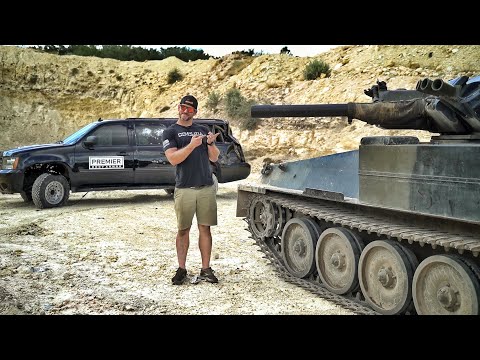
This video showcases an expert-level ballistic test of a $300k armored Chevrolet Suburban against military-grade threats. The demonstration, led by individuals with clear expertise in armor and ballistics, includes impacts from a 76mm tank round and a high-explosive shape charge. The armored Suburban, featuring 1/2 inch AR500 steel and 50 BMG-rated ballistic glass, demonstrates significant resistance, stopping all but dedicated anti-tank projectiles and maintaining structural integrity under extreme duress.
This video provides a comprehensive test of the RTS Tactical Level 3A Ballistic Shield, demonstrating its effectiveness against various handgun calibers up to .44 Magnum. Expert shooter Edwin Sarkissian highlights the shield's performance, including its ballistic glass viewport, and clearly shows its limitations when faced with rifle rounds. The guide emphasizes safe firearm handling and thorough testing procedures for ballistic protection equipment.
This video features Edwin Sarkissian, a high-profile tactical gear influencer, conducting an experimental test of a TenPoint Nitro XRT crossbow against the 1.5-inch thick armored glass of a GMC Denali SUV, modified by Armormax. The test demonstrates the effectiveness of the ballistic glass, with the arrow failing to penetrate even a pre-damaged section. The video highlights the crossbow's velocity and cocking system, as well as the SUV's defensive features.
This video features a Ruger 10/22 rifle firing .22LR ammunition at a piece of bulletproof glass to determine how many shots are required to penetrate it. The content creator aims to provide an engaging visual demonstration of the .22LR's effectiveness against ballistic materials. The description also includes links for channel support via Patreon and the creator's Instagram page.
Gun Laws by State
Read firearms regulations for all 50 states + D.C.
Find Gun Dealers
Search licensed FFL dealers near you.