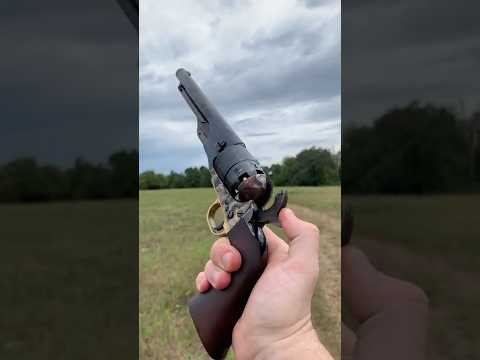
This video provides a foundational comparison between cap and ball revolvers and metallic cartridge revolvers, detailing the loading process for each. It highlights the distinct steps involved in preparing and firing a cap and ball firearm, including powder, wads, balls, and percussion caps. The comparison then contrasts this with the simpler, self-contained nature of metallic cartridges, noting the potential cost and consistency differences.
This video provides a detailed comparison between cap and ball revolvers and metallic cartridge revolvers, focusing on their loading mechanisms and operational differences. It explains the step-by-step process for loading a cap and ball revolver, highlighting the use of separate components like powder, balls, and percussion caps. The presenter, Dustin from Guns of the West, also discusses the convenience and modern advantages of metallic cartridge revolvers, including their compatibility with smokeless powder and the option of conversion cylinders for older cap and ball models. He concludes that neither type is inherently more entry-level, offering different paths for new shooters.
This video provides a detailed examination of the Gwyn & Campbell carbine, also known as the Cosmopolitan or Union carbine, used during the US Civil War. It covers the carbine's history, development, operational mechanics, and the differences between Type 1 and Type 2 models. The presenter, Ian McCollum of Forgotten Weapons, highlights its role as an intermediary design between muzzleloaders and metallic cartridge firearms.
This guide details the loading and firing process for the Allen & Thurber Pepperbox, a firearm popular during the Gold Rush era. It covers essential steps from powder loading to projectile ramming, emphasizing safety and operational characteristics. The video highlights the pepperbox's utility as a close-range self-defense weapon, contrasting it with later revolver designs like the Colt 1849. Expert instruction is provided on its operation and historical context.
This guide details the historical process of loading a percussion revolver, specifically referencing models like the Colt 1851 Navy and Pietta replicas. It covers the standard procedure of charging chambers with powder, seating projectiles, and capping nipples. The video emphasizes efficiency methods and provides historical context for the popularity of these firearms, concluding with a live-fire demonstration. The instruction comes from a high-authority source demonstrating expertise in historical firearms handling.
This video, featuring expert Hickok45, challenges the notion that smoothbore muskets were ineffective. Through demonstrations and historical context, it highlights their lethality, especially with "Buck and Ball" loads, proving their utility within 100 yards for historical military applications. Hickok45's extensive experience with historical firearms and marksmanship is evident throughout the educational content.
This video explores the historical significance of the Harper's Ferry 1842 smoothbore musket, emphasizing its role in American history and its technical features. It demonstrates the loading process for both a standard ball and a 'buck and ball' load, highlighting the musket's effectiveness even through the Civil War. The presenter encourages viewers to develop a greater appreciation for history beyond modern firearms.
This video from Forgotten Weapons delves into the Pauly/Roux breechloading pistols, highlighting Samuel Pauly's 1808 patent for the first self-contained metallic-based cartridge and Henri Roux's subsequent improvements. Expert Ian McCollum details the innovative fire piston mechanism and striker-fired systems, discussing their historical context, mechanical principles, and eventual influence on later firearm designs. The presentation emphasizes the craftsmanship and historical significance of these early breechloaders, drawing from museum provenance.
This YouTube video investigates the accuracy of caplock muzzleloaders. It aims to determine how precise these historical firearms are, likely through range testing and performance analysis. The content focuses on the capabilities and limitations of muzzleloading rifles, particularly those that use a percussion cap ignition system.
This guide details the process of testing the accuracy of a vintage Hawken-style muzzleloader, from initial setup with modern optics to long-range engagement. It emphasizes traditional loading techniques combined with modern ballistic calculation tools. The presenter, demonstrating high expertise, concludes that while effective at 100-200 yards, this type of muzzleloader is outclassed by modern inline rifles at extreme distances.
This review of the Uberti Whitneyville Dragoon reproduction highlights its historical significance as a transition model between the Colt Walker and Dragoon series. The video details the process of loading with 50 grains of powder and .454 balls, demonstrating its powerful 'big boom' capability. It also addresses common issues like cap jams and the loading lever falling, offering practical advice for owners.
This guide details the proper loading and firing procedure for the 1847 Colt Walker revolver. It emphasizes using historically appropriate powder flasks and volumetric measures for consistent powder charges, recommending Colt's advised maximum of 50 grains. The process involves filling chambers, seating charges with the loading rod, and capping the nipples, with a crucial reminder about the importance of cleaning black powder firearms.
Gun Laws by State
Read firearms regulations for all 50 states + D.C.
Find Gun Dealers
Search licensed FFL dealers near you.