This guide details the loading and firing process for the Allen & Thurber Pepperbox, a firearm popular during the Gold Rush era. It covers essential steps from powder loading to projectile ramming, emphasizing safety and operational characteristics. The video highlights the pepperbox's utility as a close-range self-defense weapon, contrasting it with later revolver designs like the Colt 1849. Expert instruction is provided on its operation and historical context.
This video demonstrates the process of loading and firing a Pietta Traveling 1858, a reproduction of the Remington New Model Army, using paper cartridges. The presenter, Dustin from Guns of the West, walks through the steps of preparing the cylinder, inserting cartridges, seating bullets, applying lube, and capping the nipples. He then provides shooting impressions at approximately 15 yards, noting the effectiveness of both curr bullets and round balls.
This guide details the traditional process of loading and firing a Kentucky Long Rifle, as demonstrated by Misha. It covers casting lead projectiles using a Lee Precision mold, the specific sequence for loading black powder, patch, and ball, and the priming and firing of the flintlock mechanism. The instruction emphasizes high expertise in historical firearms and traditional shooting methods.
This video compares the historical flintlock rifle with a modern .308 Winchester rifle, highlighting differences in projectile technology, loading procedures, and accuracy. It demonstrates the mechanics of flintlock ignition, the evolution of projectiles from round balls to modern bullets, and the impact of optics and rifling twist rates on accuracy. The comparison concludes that while flintlocks offer historical romance and surprising accuracy with iron sights, modern rifles with scopes provide superior precision and ease of use.
This video demonstrates the historical reloading and firing process for a 1770s Charleville flintlock musket, modified into a carbine. It details the use of paper cartridges, priming the pan, loading the powder and ball, and the challenges of rapid firing without modern sights. The demonstration highlights the difficulty of achieving multiple hits in a minute with such a firearm.
This video demonstrates the process of loading and firing paper cartridges in a Colt's Third Model Dragoon revolver, replicated by Uberti. It covers using both round ball and Johnston and Dow conical bullets with a 40-grain charge of 3fg Goex powder. The demonstration includes loading techniques, application of bullet lube, capping, and firing, with a comparison of the resulting target groups.
This video addresses frequently asked questions about using paper cartridges with cap and ball revolvers. It confirms that round balls can be used instead of conical bullets and that no hole needs to be poked in the cartridge for ignition. The presenter clarifies that combustible cartridges are loaded as-is, and while paper residue may remain, it generally doesn't hinder subsequent shots. Best practices for storage, preventing hang fires and chain fires, and using black powder substitutes are also discussed.
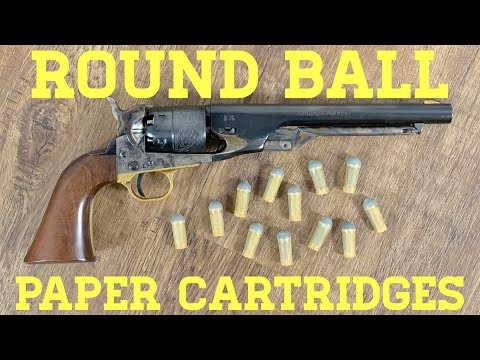
This guide details the creation and loading of round-ball paper cartridges for the 1860 Army Revolver, utilizing the Guns of the West kit. Expert instruction covers assembling the cartridges, measuring black powder charges, seating and lubricating round balls, and finally loading the revolver with percussion caps for live fire. The demonstration emphasizes reliable ignition and accuracy at an outdoor range.
This guide details the black powder loading process for the 1805 Harpers Ferry Flintlock pistol and provides expert troubleshooting for common 'flash in the pan' misfires, as demonstrated by Hickok45. It emphasizes safety and proper maintenance for historical firearms.
This guide details the technique for loading and firing the 1850-60's Confederate Swivel Breech Rifle, as demonstrated by an expert from InRangeTV. It covers the process of loading powder, seating round balls, capping the nipples, and firing both barrels, emphasizing the unique swivel breech mechanism. The guide also includes essential safety warnings for handling muzzle-loading firearms.
This video demonstrates two methods for lubricating black powder revolver chambers: traditional beeswax and tallow mixture versus modern pre-lubricated felt wads. The demonstration uses a Pietta Remington New Model Army in .44 caliber with 30 grains of Goex 3FG black powder and .454 round balls. The results show that while both methods improve accuracy and reduce fouling compared to no lube, the pre-lubricated felt wads provided superior accuracy and cleaner bore performance.
This guide details the loading and firing technique for the 1841 Mississippi Rifle, a historical percussion muzzleloader. It covers essential steps from powder loading to firing, emphasizing the use of black powder and patched round balls. The information is presented with the authority of firearms expert Hickok45, highlighting the rifle's historical significance and operational nuances.
Gun Laws by State
Read firearms regulations for all 50 states + D.C.
Find Gun Dealers
Search licensed FFL dealers near you.