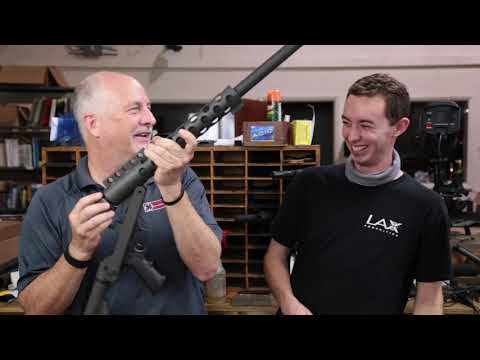
This video details the design and testing of a prototype 3D-printed lower receiver intended for the Lima Six belt-fed upper. Key design considerations include a high dovetail for a short belt feed path to minimize jams and a two-piece construction for optimal print orientation and strength. The presenter discusses findings after 600 rounds, including issues with gas deflection and potential improvements for takedown pin placement and bolt catch functionality.
This video details the ongoing testing of the PSA Dagger, nicknamed 'Tatiana,' after encountering several failure points at approximately 4,000 rounds. The host outlines specific issues including light primer strikes, a loose front sight post, a dislodged slide release, a point of impact shift, and a walking takedown pin. A plan is presented to address these issues locally, with the intention of continuing the test to a higher round count, while also introducing the Ruger RXM for parallel testing.
This video provides a detailed guide to disassembling and cleaning the SIG AMT rifle. Mark Serbu, a gun designer, walks viewers through the process, highlighting unique features like the winter trigger and loaded chamber indicator. He emphasizes the rifle's Swiss engineering and its similarities to the German MG42, offering insights into its internal mechanisms and maintenance.
This guide demonstrates the installation of Aero Precision EZ Install pins for an AR-15. The video highlights the differences between these pins and standard milspec pins, particularly the pivot pin's integrated tool feature. It provides a step-by-step process for installing the pivot pin using a punch to manage the detent and spring, simplifying the assembly process and reducing the risk of losing small parts.
This guide details the installation of essential components within an AR-15 lower parts kit, as demonstrated by an expert firearms instructor. It covers the buffer retainer, magazine catch, safety selector, bolt catch, and pivot/takedown pins, offering practical installation tips and highlighting potential pitfalls. The instruction emphasizes understanding each part's function and proper assembly for optimal firearm performance and reliability.
This video tutorial focuses on the installation of two key components of an AR-15 rifle: the receiver extension (buffer tube) and the takedown pin. The content is aimed at individuals interested in building, maintaining, or customizing their AR-15 firearms.
This video provides an in-depth review and historical overview of the RN 50 rifle, designed by Mark Serbu and named after Royal Nonesuch. Mark discusses the design origins, technical specifications, and production challenges, including the inspiration from the Stormgevare takedown pin and the decision to use a non-interrupted thread system for safety. He also shares trivia about the barrel shroud, breech cap, and hammer design, highlighting the modularity with AR-15 components and the rifle's compact transportability.
This guide details a comprehensive inspection of an Anderson AM-15 lower receiver, focusing on critical dimensions and function. The process, led by an expert from School of the American Rifle, utilizes specialized gauging tools to ensure mil-spec compliance and proper assembly. Key checks include fire control group function, trigger pull weight, pin hole tolerances, and receiver milling quality, providing a methodical approach to verifying lower receiver integrity.
This review of the Czech VZ 58 by AK Operators Union highlights its distinct design from the AK platform, despite superficial similarities. The rifle features a milled receiver, a German-made barrel known for accuracy, and comes in a sporting configuration with an M4 stock and side rail. The presenter emphasizes its fun shooting characteristics and details a basic takedown procedure, noting the differences in internal components and safety mechanism compared to an AK.
This guide details the installation of an A2 Style Buttstock onto an AR-15 lower receiver, presented by Larry Potterfield of MidwayUSA. It covers the essential steps, including preparing the buffer tube with a spacer, installing the takedown pin, detent, and spring, and finally securing the buttstock. The instruction emphasizes careful handling of small components and proper lubrication for a smooth assembly process.
This guide details the essential inspection and preparation steps for an AR-15 lower receiver before assembly. It emphasizes cleaning out detent and pin holes using specific drill bit sizes and a pin vise, and cleaning pistol grip screw threads with a tap. Proper prep work ensures easier assembly and a functional firearm.
This guide details a practical technique for replacing an AR-15 takedown pin, even when the castle nut is staked, without disturbing the staking. It utilizes a small precision screwdriver to manage the detent and a longer pivot pin as a slave to facilitate the swap. This method is ideal for upgrading components like enhanced pins.
Gun Laws by State
Read firearms regulations for all 50 states + D.C.
Find Gun Dealers
Search licensed FFL dealers near you.