This guide details a demonstration of the Nambu Type 94's critical design flaw: an exposed transfer bar/sear that allows for accidental hammer release. Expert instruction emphasizes safety precautions, including the use of dummy rounds and the avoidance of dry firing antique firearms. The demonstration highlights how pressure on this exposed mechanism bypasses the trigger safety, a known issue that persisted despite manufacturer awareness.
The Yankee Marshal outlines essential modern features for carry guns, emphasizing safety, ergonomics, and modern sighting systems. He argues that drop safety (firing pin block, transfer bar, or hammer block) is non-negotiable, alongside comfortable and ergonomic grips. Replaceable sights are crucial for aging eyes, and the ability to accept a red dot optic is now a standard expectation for most modern firearms.
This video by TheYankeeMarshal discusses essential safeties for carry guns, emphasizing passive safety mechanisms over manual ones. The instructor highlights the importance of firing pin blocks or hammer blocks for semi-automatics and revolvers to prevent accidental discharge from impacts or drops. Community members share their preferences, ranging from internal drop safeties to decockers, with a general consensus favoring internal mechanisms that prevent unintended firing.
This video provides a historical overview and detailed look at the Colt Trooper Mk III revolver. The presenter highlights its .357 Magnum chambering, 6-inch barrel, blued finish, and wood grips. It discusses the evolution of the Trooper series, noting the Mark III's production run from 1969 to 1985 and its internal safety features like the transfer bar.
This video provides a detailed breakdown of the Colt 1900's internal mechanisms, highlighting its historical significance as the first pistol to feature a modern slide. It explains the recoil-operated system, the barrel locking mechanism via lugs and swinging links, and the unique trigger and disconnector interaction. The safety features, including the half-cock hammer and the combination rear sight/safety lever, are also elucidated.
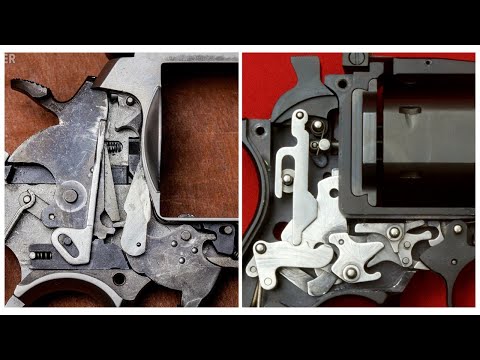
This video explains the function and safety implications of transfer bars in revolvers. It contrasts revolvers with and without transfer bars, demonstrating how the transfer bar acts as an intermediary between the hammer and firing pin, enhancing safety by preventing direct contact with the primer when the trigger is not pulled. The presenter highlights that revolvers without transfer bars require specific loading practices, like the 'cowboy load,' to mitigate accidental discharge risks.
This video provides an in-depth, advanced-level disassembly and internal inspection of the rare Mateba MTR-6 revolver. The instructor meticulously takes the firearm apart, explaining the function of its unique components, including the low bore axis design, the complex sear and transfer bar mechanisms, and the method for setting cylinder gap. The content is aimed at experienced gunsmiths or advanced enthusiasts seeking to understand the intricate workings of this unusual firearm.
This video explains the internal mechanics of the British Webley Self-Loader MkI pistol. It details the single-action, hammer-fired system, including how the trigger pull initiates the firing sequence via a transfer bar and sear. The explanation covers the unique locking action that engages the barrel and slide, the recoil system powered by a V-spring, and the function of the grip safety as the sole safety mechanism.
This video explains the safety mechanisms of single-action revolvers, focusing on the interaction between the hammer notches and the sear. It clarifies that the firearm cannot be fired without pulling the trigger, debunking claims made in the context of the Alec Baldwin incident. The instructor details the 'safe position' and 'firing position' notches and explains how modern safety features like transfer bars further prevent accidental discharge.
This video features a live Q&A session where the host, The Yankee Marshal, discusses various firearms-related topics. Key insights include the normal rattling of a Ruger LCR's transfer bar, which indicates proper function, and the comparison of rattling in 1911s and Luger pistols. The discussion also touches on firearm maintenance and reliability, emphasizing that certain noises are expected and not indicative of a problem.
This guide details the internal safety mechanisms of modern revolvers, specifically the transfer bar and hammer block systems, as explained by Hickok45. It covers how these safeties prevent accidental discharges by ensuring the hammer cannot strike the firing pin unless the trigger is intentionally pulled. The explanation includes visual demonstrations of Ruger and Smith & Wesson designs and touches upon the historical evolution of these safety features in revolvers.
This guide, based on expert analysis from TheYankeeMarshal, debunks the 'Hair Trigger Fallacy' regarding semi-automatic vs. revolver safety. It details how modern semi-autos and revolvers employ internal safeties that require a deliberate trigger pull, comparing specific trigger weights and emphasizing that safe carry relies on knowledge, proper equipment like holsters, and consistent safe handling habits.
You've reached the end! 12 videos loaded.
Gun Laws by State
Read firearms regulations for all 50 states + D.C.
Find Gun Dealers
Search licensed FFL dealers near you.