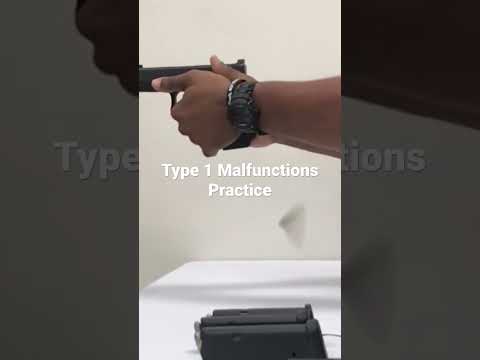
This video demonstrates how to clear common firearm malfunctions, specifically Type 1 and Type 2. The instructor emphasizes a systematic approach to ensure the firearm is safe and ready to fire again, stressing the importance of proper procedure to avoid further issues. The core technique involves identifying the malfunction, manipulating the firearm to clear it, and then re-acqureing a firing grip and sight picture.
This guide details a practical drill for practicing Type 1 malfunction clearances, as demonstrated by Instructor Mike. It emphasizes the 'Tap, Rack, Roll' technique using a mix of live rounds and SnapCaps to build muscle memory for clearing common firearm failures quickly and efficiently. The drill focuses on maintaining a proper grip and sight alignment post-clearance to rapidly return to a firing position.
This video provides expert instruction from Instructor Mike on practicing the Type 1 Malfunction clearing drill, specifically the 'Tap-Rack-Assess' technique. It emphasizes fluid firearm manipulation and repetitive practice for efficient malfunction resolution with a Glock 19. The guide details the steps for clearing a failure to fire, crucial for any semi-automatic pistol owner.
This guide details the 'Tap, Rack, Assess, Press' technique for clearing Type 1 malfunctions (failure to fire) on a Glock pistol, as demonstrated by Instructor Mike. The method emphasizes maintaining situational awareness while performing immediate action drills to quickly resolve the malfunction and re-engage a threat if necessary. This is a fundamental skill for any pistol owner.
This video demonstrates and discusses potential malfunction clearance issues, particularly with the 1911 and Beretta 92FS platforms. Instructor Mike highlights how the manual safety on these firearms can inadvertently be activated during a 'tap rack' drill, leading to a double-action trigger pull instead of single-action. He advocates for striker-fired pistols or firearms without external safeties for simpler malfunction resolution.
Jeff Gonzalez of Trident Concepts demonstrates essential AR-15 magazine changes and malfunction clearances for Brownells Daily Defense. The guide covers reloads with an open and closed action, emphasizing the 'push-pull' technique for magazine seating. It details clearing Type 1 (failure to fire) and Type 2 (failure to feed/eject) malfunctions using the 'tap, tug, roll, rack' immediate action drill, stressing safety and consistent execution.
Instructor Mike introduces 'On-the-Spot Training' focusing on essential firearm malfunction clearance drills. He details procedures for Type 1 (click/no boom), Type 2 (stovepipe), and Type 3 (jam) malfunctions, emphasizing the TRAP (Tap, Rack, Assess, Press) and RRI-RRP (Rip, Rack, Insert, Rack, Assess, Press) methods. The importance of maintaining situational awareness on the threat during clearance and practicing with snap caps is highlighted.
This video by Instructor Mike provides a practical guide to clearing Type 1 (failure to fire) and Type 2 (failure to eject) malfunctions. The core technique demonstrated is the 'tap, rack, assess' method, emphasizing forceful magazine seating, slide manipulation, and continuous threat assessment. The instructor uses snap caps for safe practice, recommending multiple magazines and rounds for effective repetition.
This video details the IDF's five-step method for clearing AR-15/M16 malfunctions: Identify, Move, Clear, Reload, and Re-engage. It categorizes malfunctions into Type 1 (click), Type 2 (bolt not closed/open), and Type 3 (bolt locked open, empty mag). The IDF's technique emphasizes moving to cover for Type 2 and 3 malfunctions and includes a 'pull' check after magazine insertion to ensure security, a departure from the standard 'tap, rack, bang'.
This video from USCCA's Tactical Tuesday series demonstrates how to clear a Type 1 firearm malfunction using only one hand. Instructors Steve Fischer and Mike Brickner explain and demonstrate a technique involving slapping the magazine to ensure it's seated, then using the firearm's rear sights against a pocket or belt to rack the slide and clear the malfunction. The drill emphasizes the importance of being able to clear stoppages when a support hand is unavailable.
This video, "The Type 1 Malfunction: Into the Fray Episode 24," focuses on immediate action during a critical firearm failure, specifically when expecting a shot and instead hearing a "click." It emphasizes the importance of getting to cover and then executing the "Slap, Rack, and Roll" technique to clear the malfunction and return the pistol to a firing state. The presenter strongly advises practicing these steps with dummy ammunition or snap caps and strictly prohibits live ammunition during dry-fire training. The video also promotes USCCA resources and offers a gun giveaway.
You've reached the end! 11 videos loaded.
Gun Laws by State
Read firearms regulations for all 50 states + D.C.
Find Gun Dealers
Search licensed FFL dealers near you.