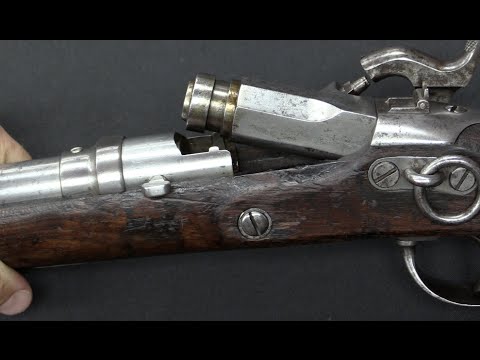
Lindner's Improbable Tube-Fed Striker-Fired Caseless Ammo Revolver

Published on December 6, 2021
Duration: 13:12

This guide details the mechanical intricacies of Edward Lindner's improbable tube-fed, striker-fired, caseless ammo revolver proof-of-concept. It covers the multi-step cocking cycle, the rack and pinion feeding system, the automatic percussion cap magazine, and the design's inherent limitations as a non-firing model. The analysis highlights Lindner's innovative, albeit complex, approach to firearm design in the mid-19th century.

Quick Summary

Edward Lindner's tube-fed, striker-fired revolver was a 19th-century proof-of-concept featuring .48 caliber caseless combustible cartridges. Its complex mechanism included a rack and pinion feeder and an automatic percussion cap magazine, though it was not designed for firing due to intentional design limitations.

Chapters

  1. 00:00Introduction to the Lindner Revolver
  2. 00:28Edward Lindner's Background
  3. 00:58Mechanical Overview
  4. 01:45Ammunition and Capacity
  5. 02:31Proof-of-Concept Limitations
  6. 03:30Internal Feeding Mechanism
  7. 05:58Percussion Cap Magazine
  8. 08:20Modular Magazine Potential
  9. 10:21Historical Context and Other Patents

Frequently Asked Questions

What makes the Lindner Revolver unique among firearms of its era?

The Lindner Revolver is notable for its proof-of-concept design featuring a tube-fed, striker-fired action and utilizing .48 caliber caseless combustible cartridges, representing an ambitious but complex approach to firearm innovation in the mid-19th century.

How does the Lindner Revolver's feeding mechanism work?

It employs a rack and pinion system to move a feed rod, which pushes cartridges sequentially from the tubular magazine into the cylinder chambers during the cocking cycle. This mechanism is part of a complex six-operation sequence initiated by the cocking lever.

Why was the Lindner Revolver considered a proof-of-concept and not a functional firearm?

The model was intentionally designed as a non-firing demonstration. Key limitations included a striker too short to ignite the primer and a barrel secured only by a set screw, incapable of withstanding the pressures of firing.

What was the potential capacity of the Lindner Revolver design?

The primary tube magazine held nine rounds, but Lindner envisioned a modular system allowing for the attachment of multiple tubes, potentially increasing the capacity to 27 or more rounds, offering a significant firepower advantage for its time.

Related News

All News →

More Gunsmithing & DIY Videos You Might Like

More from Forgotten Weapons

View all →