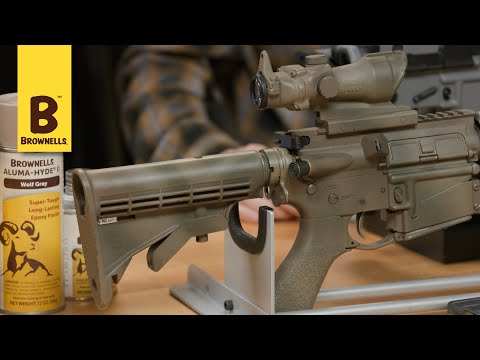
Quick Tip: Using Cardboard For Holding Parts

Published on January 12, 2024
Duration: 2:34

This quick tip from Brownells demonstrates an effective and simple method for holding small firearm parts during painting and finishing processes. By pushing parts like screws, pins, and safety levers through a piece of cardboard, builders and gunsmiths can create a stable jig for applying finishes. This technique is suitable for both air-curing finishes like Aluma-Hyde II and oven-cured coatings such as Cerakote and Gun-Kote, as the cardboard's ignition point is significantly higher than typical curing temperatures.


Quick Summary

A simple cardboard jig can be created by pushing small firearm parts like screws, pins, and safety levers through the material. This method is safe for applying both air-curing finishes (e.g., Aluma-Hyde II) and oven-cured coatings (e.g., Cerakote, Gun-Kote) because typical curing temperatures are well below cardboard's ignition point of approximately 400°F.

Chapters

  1. 00:04Introduction: Cardboard for Parts
  2. 00:20Demonstrating the Cardboard Jig
  3. 00:30Air vs. Oven Curing Finishes
  4. 01:01Temperature Compatibility Explained
  5. 01:38Practical Applications of the Tip
  6. 01:59Call to Action & Contact

Frequently Asked Questions

How can I hold small firearm parts securely for painting?

A simple and effective method is to use a piece of sturdy cardboard. Push small parts like screws, pins, and safety levers through the cardboard to create a stable jig. This allows for easy application of finishes from multiple angles.

Is it safe to use cardboard for holding parts during oven curing?

Yes, it is generally safe as long as the curing temperature remains below cardboard's ignition point of around 400°F. Common firearm finishes like Cerakote and Gun-Kote cure at approximately 275°F, well within this safe range.

What types of firearm finishes can be applied using a cardboard jig?

This technique works well for both air-curing finishes, such as Brownells Aluma-Hyde II, and oven-cured coatings like Cerakote and Gun-Kote. The cardboard provides a stable platform for applying these materials.

What are the benefits of using a cardboard jig for finishing firearm parts?

The primary benefit is convenience and ease of handling. It prevents small parts from rolling away or being difficult to grip, allowing for more uniform application of finishes and making the overall process more efficient.

More Gunsmithing & DIY Videos You Might Like

More from Brownells, Inc.

View all →