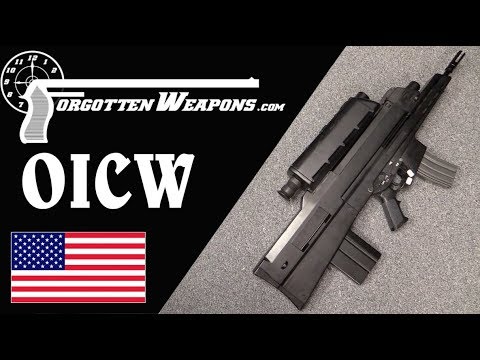
What Was The US Military's OICW Program?

Published on June 11, 2026
Duration: 10:56

This video explores the US Military's Objective Individual Combat Weapon (OICW) program, detailing its goals, key contenders like HK/ATK's XM29, and its eventual split into the XM25 grenade launcher and XM8 rifle. It highlights the program's focus on defeating cover with airburst technology and discusses the challenges faced, including weight, cost, and effectiveness, ultimately leading to its cancellation.


Quick Summary

The US Military's Objective Individual Combat Weapon (OICW) program aimed to create a firearm capable of defeating enemies behind cover using an airburst capability. This led to the development of the XM29 OICW, which was later split into the XM25 grenade launcher and the XM8 rifle, though both faced significant challenges and were eventually canceled.

Chapters

  1. 00:00Introduction to OICW Program
  2. 00:14OICW Program Goals: Defeating Cover
  3. 00:51Airburst Technology Explained
  4. 01:31Key Entrants: HK/ATK and AAI
  5. 02:13The XM29 OICW: Design and Features
  6. 03:10XM29 Program Challenges: Weight, Cost, Barrel Length
  7. 04:49Program Split: XM25 and XM8
  8. 05:31The XM8 Rifle: Modularity and Appearance
  9. 06:39XM25 Development and Limited Use
  10. 07:19XM25 Cancellation and Reasons
  11. 08:16Legacy of OICW and Future Programs

Frequently Asked Questions

What was the main goal of the US Military's OICW program?

The primary objective of the OICW program was to develop a new individual combat weapon system for the U.S. military that could effectively defeat enemy combatants concealed behind cover, not by penetrating the cover itself, but by employing an airburst capability to deliver munitions indirectly.

What were the key weapon systems developed under the OICW program?

The OICW program initially led to the development of the XM29 OICW, which was later split into two separate systems: the XM25 grenade launcher, designed for airburst capabilities, and the XM8 rifle, a modular firearm intended to replace the standard service rifle.

Why was the XM29 OICW program ultimately unsuccessful?

The XM29 OICW faced significant hurdles including exceeding weight and cost requirements, a short barrel length on its rifle component that hampered ballistics, and insufficient lethality from its 20mm grenades, leading to its cancellation and program split.

Did any part of the OICW program see operational use?

Yes, the XM25 grenade launcher saw limited operational use by U.S. forces in Afghanistan between 2010 and 2013. The XM8 rifle, though not adopted by the U.S. military, was acquired by some international police forces and the Malaysian Navy special forces.

More Reviews Videos You Might Like

More from ClassicFirearms

View all →