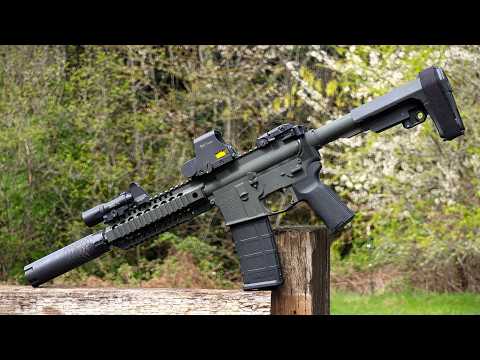
Auto Rifleman Loadout | IARs & Kit for Civilians

Published on August 9, 2025
Duration: 61:19

This video explores the concept of the Infantry Automatic Rifle (IAR) for civilian use, comparing it to traditional machine guns like the SAW. It details the technical aspects of building and outfitting an IAR for sustained fire, focusing on heat management, barrel selection, gas systems, and loadout strategies for carrying increased ammunition. The presenters emphasize the IAR's role as a force multiplier and a versatile platform for civilian applications.

Quick Summary

Infantry Automatic Rifles (IARs) offer significant advantages over older machine guns like the SAW, boasting lighter weight (around 9 lbs vs. 19 lbs) and much higher accuracy (1-2 MOA semi-auto, 3-4 MOA full-auto). This allows for greater mobility and precise fire, enabling a shift from 'accuracy by volume' to effective, accurate engagement.

Chapters

  1. 00:03:00Intro & Scenario
  2. 00:51:00Historical Context: John Basilone
  3. 00:53:00IARs vs. SAW: The Shift
  4. 01:16:00SAW Weaknesses: Weight & Accuracy
  5. 01:45:00Accuracy by Volume
  6. 02:09:00IAR Advantages: Accuracy & Weight
  7. 02:47:00Ammunition Loadout Changes
  8. 03:11:00Civilian IAR Builds
  9. 03:28:00Sponsors & Gear Overview
  10. 04:48:00Red Right Hand Upper Build
  11. 06:07:00Barrel & Heat Management
  12. 09:01:00Gas Tube & System
  13. 10:58:00Adjustable Gas Block
  14. 11:10:00Bolt Carrier Group & Gas Rings
  15. 12:12:00Drew's Build: SOCOM Barrel & Suppressor
  16. 14:38:00Laser Aiming Module & Light
  17. 14:47:00Handguard Comparison: Quad Rail vs. M-LOK
  18. 15:54:00Thermal Optics
  19. 16:33:00Stock & Magazine Capacity (D60)
  20. 17:01:00Bipod Considerations
  21. 17:50:00Optics with BDC Reticles
  22. 18:28:00Bipod Deployment Aids
  23. 19:29:00Holosun DRS Thermal & EOTech Magnifier
  24. 20:30:00IAR vs. Rifleman Loadout
  25. 21:38:00Ammunition Loadout Details
  26. 26:04:00Magazine Selection: 30, 40, 60 Rounders
  27. 29:29:00Banding & Magazine Staging
  28. 30:30:00Medical Kit Placement
  29. 31:38:00Dump Pouch Considerations
  30. 33:04:00Comms & Plate Carrier Setup
  31. 34:39:00Assault Pack Contents
  32. 37:48:00Role Responsibilities: Imp Placement & Camouflage
  33. 39:07:00Split Rig vs. Standard Rig
  34. 41:07:00Mindset & Role Understanding
  35. 43:07:00IAR as a General Purpose Rifle (GPR)
  36. 47:07:00AR Platform Advantages: Parts & Mobility
  37. 49:51:00Building a GPR IAR
  38. 50:43:00Tribute to Nick
  39. 53:00:00Nick's Departure & Chad's Arrival
  40. 54:00:00Motorsports Industry Move
  41. 58:00:00Final Words & Channel Future

Frequently Asked Questions

What are the main advantages of an Infantry Automatic Rifle (IAR) over a traditional SAW?

IARs like the HK M27 offer significant advantages over older SAWs, primarily in weight reduction (around 9 lbs vs. 19 lbs) and improved accuracy (1-2 MOA semi-auto, 3-4 MOA full-auto vs. 10 MOA). This allows for greater mobility and more precise fire, shifting from 'accuracy by volume' to accurate fire.

How does an IAR's heat management differ from a standard rifle?

IARs are designed for sustained fire, requiring enhanced heat management. This includes using heavier barrels (e.g., 20-inch, 4150 chrome molly), incorporating heat sinks around the barrel and gas tube, and utilizing rifle-length gas systems to dissipate heat more effectively before it reaches the action.

What is a recommended ammunition loadout for a civilian auto rifleman?

A civilian auto rifleman loadout should aim for around 600-660 rounds. This can be achieved using a mix of 30, 40, and 60-round magazines (like D60s), carried on a chest rig or bandolier, supplemented by additional magazines in a pack or assault pack.

Why is the AR-15 platform a good choice for building an IAR?

The AR-15 platform's widespread availability of parts makes it ideal for IAR builds. This ensures easy access to replacement components like barrels, gas rings, and action springs, and allows for quick modularity, such as swapping uppers, which is crucial for maintenance and customization.

What are the key considerations for a civilian IAR build?

Key considerations include a robust barrel for heat resistance, effective heat management systems (heat sinks), a reliable gas system (straight tube, rifle-length), sufficient ammunition capacity (600+ rounds), and a loadout that can comfortably carry the extra weight. The goal is a versatile platform that can sustain fire while remaining manageable.

Related News

All News →

More Tactical & Gear Videos You Might Like

More from Dirty Civilian

View all →