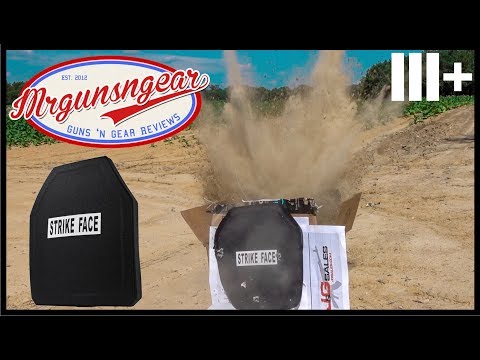
Ceramic Armor that's Actually Affordable

Published on October 17, 2021
Duration: 13:40

This video tests RMA Armors Level IV ceramic plates, focusing on their affordability and backface deformation. The plates successfully stopped 7.62x54R rounds with minimal deformation, and even held up against a .338 Lapua Magnum, though with significant deformation. The instructor emphasizes that while this testing is not scientific, it provides valuable consumer insight into the product's performance.

Quick Summary

RMA Armors Level IV ceramic plates are highlighted for their affordability at $160 per plate. They successfully stopped 7.62x54R rounds with minimal backface deformation (approx. 0.75 inches), and even .338 Lapua Magnum with significant deformation (approx. 1.875 inches). Ceramic armor functions by disintegrating upon impact, dissipating projectile energy.

Chapters

  1. 00:00Introduction to Armor Testing
  2. 00:35RMA Armors Level IV Ceramic Plates
  3. 00:46Affordability of RMA Armor
  4. 01:23Backface Deformation Claims
  5. 01:40Disclaimer on Scientific Testing
  6. 03:34Test Setup: Mosin Nagant 7.62x54R
  7. 04:18Measuring Backface Deformation
  8. 05:297.62x54R Impact Results
  9. 06:15Test Setup: .338 Lapua Magnum
  10. 06:58.338 Lapua Magnum Impact Results
  11. 07:55Performance Breakdown
  12. 08:04How Ceramic Armor Works
  13. 08:55Armor Limitations: One Shot
  14. 10:06Trade-offs in Armor Design
  15. 10:30Nij Backface Deformation Standards
  16. 11:11Test Results vs. Standards
  17. 11:56Blunt Force Trauma Reality
  18. 13:01Conclusion: RMA Armor Value

Frequently Asked Questions

What is the price point of RMA Armors Level IV ceramic plates?

RMA Armors Level IV ceramic plates are presented as an affordable option, with the video mentioning a price of $160 per plate. This price point is highlighted as a key differentiator from other ceramic armor options on the market.

How did RMA Armors Level IV ceramic plates perform against 7.62x54R ammunition?

The RMA Armors Level IV ceramic plates successfully stopped 7.62x54R ammunition during testing. The backface deformation was minimal, measured at approximately three-quarters of an inch, well within acceptable limits.

What is backface deformation in body armor?

Backface deformation refers to the indentation or bulge on the non-threat side of body armor after it stops a projectile. Standards like NIJ's 44mm limit are used to assess the risk of blunt force trauma from this deformation.

How does ceramic armor work to stop bullets?

Ceramic armor works by disintegrating upon impact. The high-velocity projectile hits the ceramic, causing both the armor and the bullet to break apart, dissipating the projectile's energy and preventing penetration.

More Tactical & Gear Videos You Might Like

More from The VSO Gun Channel

View all →