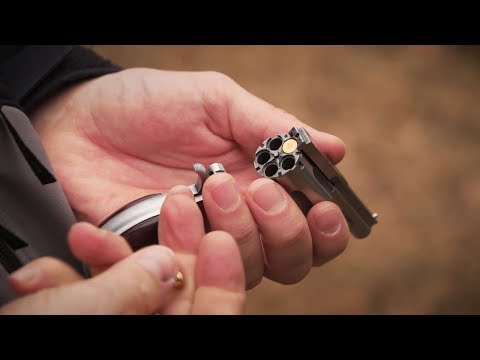
Barnes' Long-Range X Bullet: Guns & Gear|S5

Published on November 18, 2013
Duration: 4:10

This video details the testing methodology for long-range bullets, specifically the Barnes LRX. Experts from Barnes Bullets demonstrate how to simulate long-range conditions on a 25-yard range by reducing powder charges. The focus is on evaluating terminal performance, such as expansion and weight retention, in ballistic gelatin at simulated velocities corresponding to extended distances.

Quick Summary

Barnes Bullets experts demonstrate how to test long-range bullet performance on a 25-yard range by reducing powder charges to simulate lower velocities (e.g., 2016 fps at 700 yards). Tests in ballistic gelatin show the .270 cal LRX bullet achieves over 24 inches of penetration and significant expansion, highlighting its effectiveness across a wide velocity workability range.

Chapters

  1. 00:00Testing Methodology for Long-Range Bullets
  2. 00:44Introduction: .270 Caliber LRX Bullet
  3. 01:30Ballistic Gel Test & Velocity Measurement
  4. 02:05Terminal Performance Analysis
  5. 02:38Design Challenges & Versatility

Frequently Asked Questions

How can long-range bullet performance be tested on a short range?

Experts simulate long-range conditions by reducing powder charges to mimic lower velocities at extended distances (e.g., 500-700 yards). This allows for controlled testing of terminal ballistics like expansion and weight retention in ballistic gelatin on a 25-yard range.

What are the key features of the Barnes LRX bullet?

The Barnes LRX bullet features a tipped, boattail design optimized for long-range hunting. It builds on the Tipped Triple-Shock construction, offering higher ballistic coefficients for improved accuracy and reliable terminal performance across a wide range of impact velocities.

What results were observed in the ballistic gelatin test?

In a ballistic gelatin test simulating a 700-yard shot (2016 fps), the .270 caliber, 129-grain Barnes LRX bullet achieved over 24 inches of penetration and began expanding within the first two inches, creating a significant wound cavity.

Why is bullet design crucial for both close and long-range performance?

Designing a bullet that performs reliably at both high velocities (close range) and low velocities (long range) is a significant challenge. The all-copper LRX design aims to provide this versatility, ensuring accuracy and effective terminal ballistics regardless of impact speed.

More Training & Techniques Videos You Might Like

More from Gun Talk Media

View all →