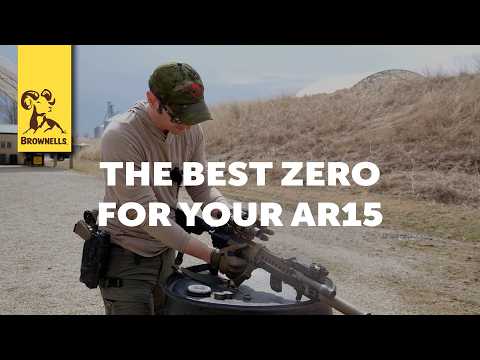
How to Zero Your Firearm - How To Shoot Part 2

Published on October 26, 2023
Duration: 35:24

This guide, presented by Lucas Botkin of T.REX ARMS, details the process of zeroing a firearm for accuracy. It covers essential concepts like 'Height Over Bore,' choosing appropriate zero distances (50/200 vs. 100 yards), and understanding Minute of Angle (MOA) for precise sight adjustments. The instruction emphasizes stability during shooting and provides specific advice for both rifle and pistol red dot sights, drawing on Botkin's expertise as a firearms instructor.

Quick Summary

Zeroing a firearm aligns your sights with the bullet's impact point at a specific distance. Key concepts include 'Height Over Bore' (distance between optic and bore centerlines) and understanding MOA (Minute of Angle, approx. 1 inch at 100 yards). A 100-yard zero is recommended for beginners for simpler aiming, requiring only hold-overs for longer distances.

Chapters

  1. 00:00Introduction to Zeroing
  2. 01:47Height Over Bore and Trajectory
  3. 03:39Choosing Zero Distances
  4. 04:56Using Zeroing Targets
  5. 07:48Stability and Shooting Position
  6. 11:20MOA and Adjustments
  7. 14:59Pistol Red Dot Zeroing
  8. 16:49Variables Affecting Zero

Frequently Asked Questions

What is the purpose of zeroing a firearm?

Zeroing a firearm ensures that your sights (like red dots or iron sights) align with the exact point where the bullet impacts the target at a specific distance. This process guarantees predictable accuracy, making your shots land where you aim them.

How does 'Height Over Bore' affect firearm zeroing?

'Height Over Bore' is the distance between the optic's centerline and the barrel's centerline. Understanding this is crucial because your sight provides a straight line, while the bullet travels in an arc. Zeroing finds the intersection point of these two lines at your chosen distance.

What is the recommended zero distance for beginners?

For beginners, a 100-yard zero is often recommended. This simplifies aiming for longer distances, as you'll primarily need to use 'hold-overs' (aiming slightly higher) for targets beyond 100 yards, avoiding the need for 'hold-unders'.

How do you adjust a firearm's zero using MOA?

MOA (Minute of Angle) relates to adjustments; 1 MOA is roughly 1 inch at 100 yards. If your shots are off, you calculate the MOA difference and convert it to clicks based on your optic's specification (e.g., 0.5 MOA per click), adjusting up/down and left/right accordingly.

Related News

All News →

More Training & Techniques Videos You Might Like

More from T.REX ARMS

View all →